




What Is the Role of DC Blower Fans in Office Equipment?
This article explains what DC blower fans are, why they are essential in office equipment, and how they support reliable, efficient cooling in real-world applications such as printers, office PCs, networking devices, and automation systems.
What Is a DC Blower Fan?
A DC blower fan is a DC fan built to deliver focused, higher-pressure airflow for cooling in tight spaces. With its centrifugal “blower” design (often nicknamed a squirrel-cage structure), it channels air in a directed stream and pushes it through narrow passages or enclosed airflow paths—making it a practical fit for office equipment where components are densely packed and ventilation routes are limited.
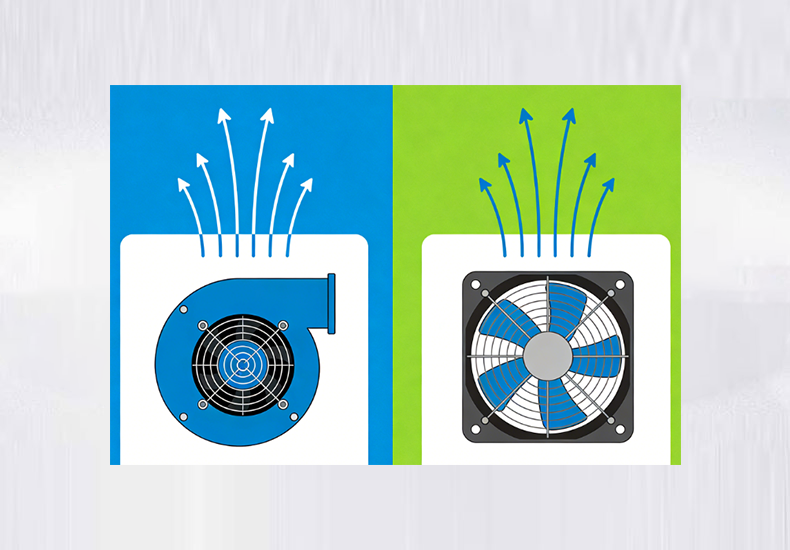
DC Blower Fan vs Axial Fan in Office Equipment
DC blower fans are better suited for high-resistance, enclosed environments than axial fans.
Feature | DC Blower Fan | Axial Fan |
Airflow Type | Focused, high-pressure | High volume, low pressure |
Performance in Ducts | Excellent | Poor |
Space Efficiency | High | Medium |
Noise Control | Better at low RPM | Less controllable |
Typical Use | Printers, copiers, OA devices | Open-frame ventilation |
Why DC Blowers Are Essential in Office Equipment
1.Targeted Thermal Management in Compact Designs
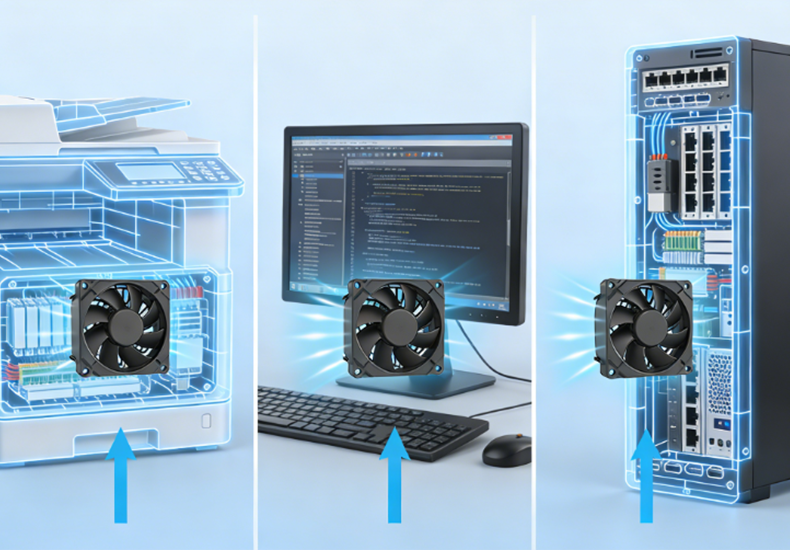
Compact office equipment often has a few“hot zones”where heat builds up quickly, and DC blower fans are a practical way to cool those areas effectively. As devices like MFP printers, mini-PCs, and scanners become smaller, heat-generating parts sit closer together and are harder to ventilate. With more focused airflow, DC blowers can send cooling air straight to key hotspots, helping keep internal temperatures stable in tight enclosures.
2.High-Pressure Airflow for High-Impedance Environments
Inside many office machines, airflow has to pass through narrow channels, filters, and complex internal paths, which naturally creates resistance. DC blowers are built to keep air moving even when the airflow path is“hard to push through,”making them well suited for these high-impedance designs. In real use, they often perform better than axial DC fans in systems that need directed airflow through specific routes rather than simple open-air circulation.
3.Operational Efficiency and Noise Reduction
A quiet working environment matters, so office equipment cooling can’t rely on fans that run loudly at high speed all day. With brushless DC motors and flexible control options such as PWM or voltage regulation, DC blower fans can operate efficiently at lower speeds for most conditions. This helps reduce power consumption while keeping noise levels more comfortable in shared office spaces.
4.Improved Reliability and Reduced Maintenance
Office devices are expected to run for long hours with minimal downtime, so reliability is a key consideration. Brushless DC blower fans reduce friction and mechanical wear, which supports longer service life and steadier cooling performance over time. In practice, that translates into fewer fan-related failures, less maintenance, and more consistent operation for equipment that runs continuously.
Typical Office Equipment Applications Overview
Office Equipment | Role of DC Blower Fan | Key Benefit |
Printers / Copiers | Cooling fusers & laser units | Prevents overheating |
Office PCs / Mini PCs | CPU/GPU cooling | Stable performance |
Network Switches | Continuous airflow | System reliability |
POS Terminals | Enclosure cooling | Reduced failure rate |
Scanners / OA Devices | Localized heat removal | Longer service life |
Common Applications of DC Fans in Office Equipment
1.Copiers and Printers
Copiers and laser printers contain several heat-heavy modules, and DC fans are commonly used to keep those areas within safe temperature limits. They direct airflow to parts like the laser/scanner section, imaging area, and the fuser zone—especially when the machine is running long print jobs. In real use, removing heat quickly helps prevent overheating, reduce jam/defect risks, and keep output quality more consistent.
2.Computers and Office Servers
Compact PCs, mini workstations, and small office servers often have limited space for airflow, so DC blower fans are used to cool components that run hot in a tight enclosure. By pushing air through confined pathways, they help manage heat around CPUs, GPUs, and power stages, which supports stable performance without requiring oversized vents or high, constant fan speed.
3.Networking Equipment
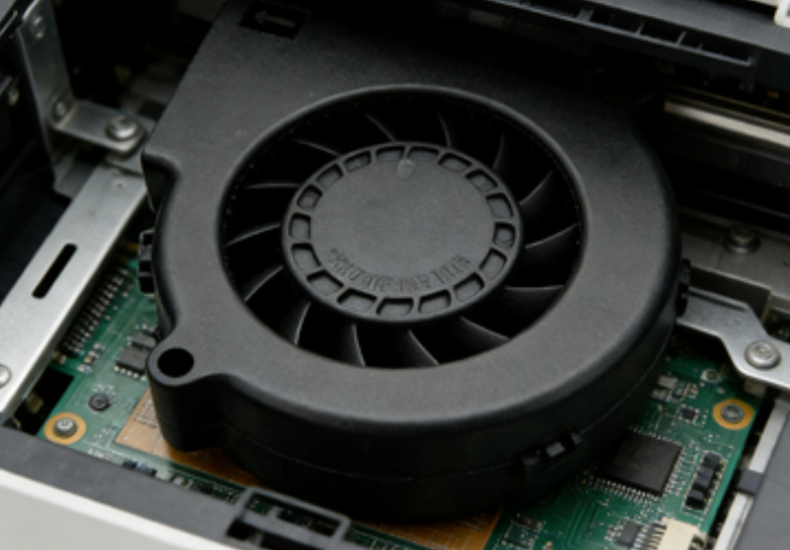
Routers, switches, and modems are typically designed for always-on operation, so steady thermal control matters for long-term stability. DC fans provide directed airflow across heat-sensitive boards and power sections, helping the device stay within a safe range during 24/7 use and reducing the chance of throttling or temperature-triggered shutdowns.
4.POS Systems and Office Automation Equipment
POS terminals, scanners, and other OA devices often run for long hours in compact housings where heat can build up quietly over time. DC blower fans are widely used here because they can deliver reliable cooling while keeping noise low, helping reduce heat-related faults and supporting smoother day-to-day operation.
Key Advantages of Using DC Cooling Fans in Office Equipment
1.Energy Efficiency
DC cooling fans can save energy because they don’t need to run at full speed all the time. With temperature-based control, the fan speeds up only when heat builds and slows down when the device is operating lightly. In real office equipment, this reduces unnecessary power draw and helps support everyday energy-saving targets.
2.Noise Control for Office Environments
Office devices are used in shared spaces, so noise matters. Because DC cooling fans can operate efficiently at lower RPM for most conditions, they keep cooling effective without creating constant fan noise. The result is a quieter user experience—especially noticeable in printers, mini-PCs, and other equipment used close to people.
3.Long-Term Reliability
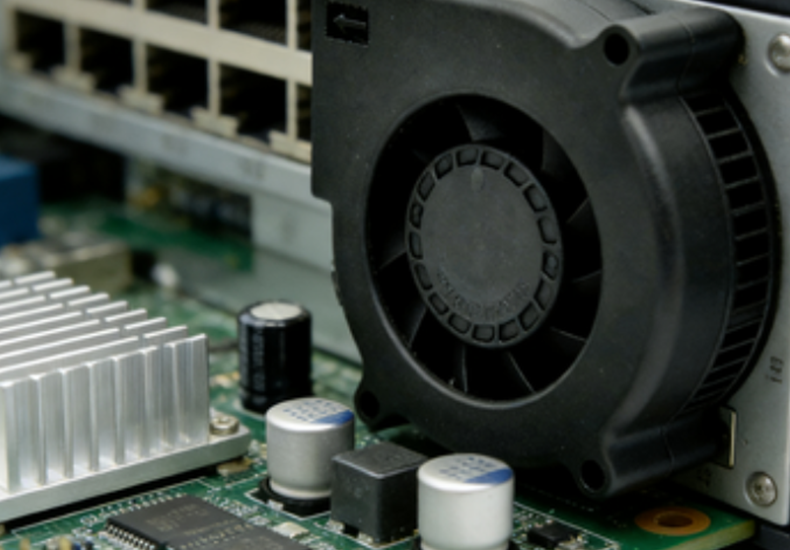
Stable cooling is one of the simplest ways to protect electronics over time. By maintaining consistent airflow and avoiding repeated overheating, DC blower fans reduce thermal stress on key components. In practical use, this helps lower failure rates, reduces service needs, and extends the working life of office equipment.
Why YCCFAN DC Blower Fans Are the Preferred DC Fan Solution for Office Equipment
As office devices get smaller but run harder for longer periods, a DC blower fan often becomes the more practical DC fan choice. Unlike fans that mainly circulate air in open space, blowers can push a more directed, higher-pressure airflow through tight housings and narrow internal channels—exactly the kind of airflow path you see in printers, copiers, mini-PCs, and other compact office equipment.
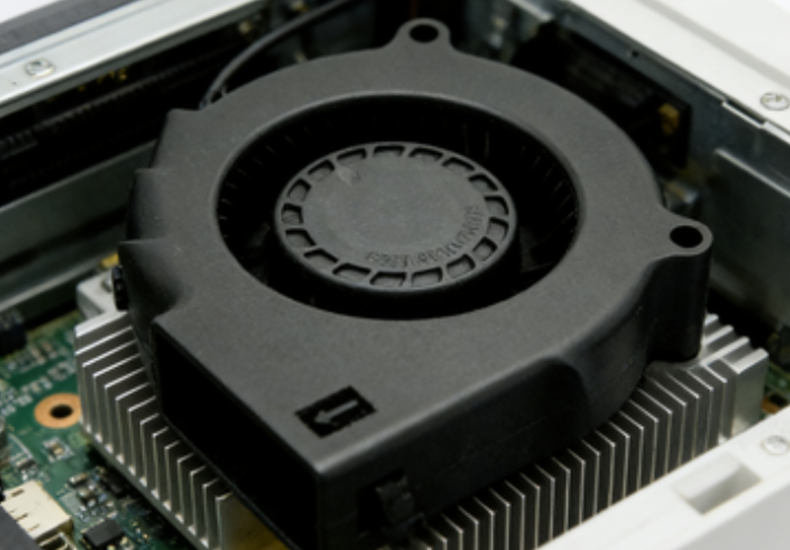
Designed for quiet operation and efficient performance, YCCFAN DC blower fans support control options such as PWM, so airflow can match real heat demand instead of running at a fixed speed. In everyday use, this helps maintain stable cooling while avoiding unnecessary power draw and constant fan noise—making blowers a dependable fit for modern office thermal management.
FAQ
1) What is the purpose of a blower fan?
To deliver focused, high-pressure airflow. Blower fans push air through ducts, filters, and tight spaces where regular airflow is restricted.
2) What is the function of a DC fan?
To provide efficient, controllable cooling using DC power. A DC fan moves air to remove heat and can be easily speed-controlled (e.g., PWM) for quieter, smarter operation.
3) What are the basic functions of fans and blowers?
Move air for cooling, ventilation, and heat removal. Fans typically circulate air in open spaces, while blowers force air through higher-resistance paths.
4) When should I choose a DC blower fan instead of an axial DC fan?
When airflow must overcome resistance. Choose a DC blower fan for narrow channels, dense components, filters, or ducted airflow paths.
5) Can a DC fan be speed-controlled for lower noise?
Yes—DC fan speed control is one of its main advantages. PWM or voltage control lets the fan run slower when cooling demand is low, reducing noise and power use.
Read more:
https://www.yccfan.com/articledetail/what-are-the-applications-of-temperature-controlled-dc-fan.html
Conclusion
In today’s office equipment, cooling is no longer just about moving air—it’s about moving air in the right place, at the right time, and with minimal noise. DC blower fans meet these demands by providing directed, high-pressure airflow that works effectively in compact, high-resistance designs. With advantages in energy efficiency, noise control, and long-term reliability, solutions such as YCCFAN DC blower fans offer a dependable approach to thermal management, helping office devices operate more quietly, efficiently, and reliably over extended service life.


