





How to Select a 48V DC Cooling Fan for Telecom and Industrial Electronics
Telecom power systems, industrial controllers, inverters, and high-density electronic enclosures often require continuous forced-air cooling under demanding operating conditions. When equipment uses a 48V DC power architecture, selecting a compatible cooling fan may seem straightforward. However, two fans with the same rated voltage can deliver very different airflow, static pressure, noise levels, and cooling results.
The challenge is not simply finding a 48V DC cooling fan. It is identifying a model that can provide sufficient airflow against the resistance of the actual equipment while meeting electrical, mechanical, and reliability requirements.
This guide explains how to evaluate 48V fan specifications, compare real model options, and select a suitable solution for telecom and industrial electronics applications.
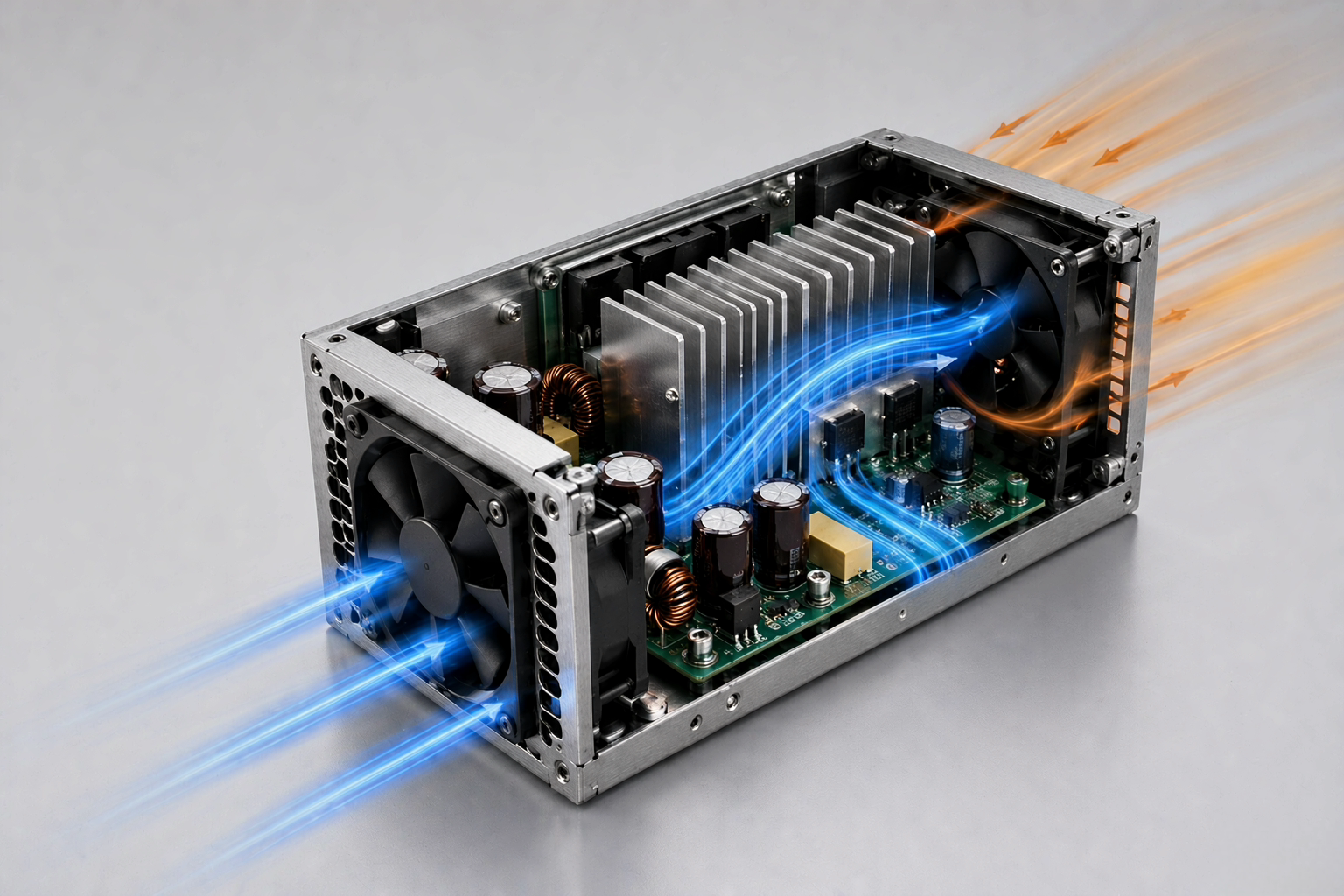
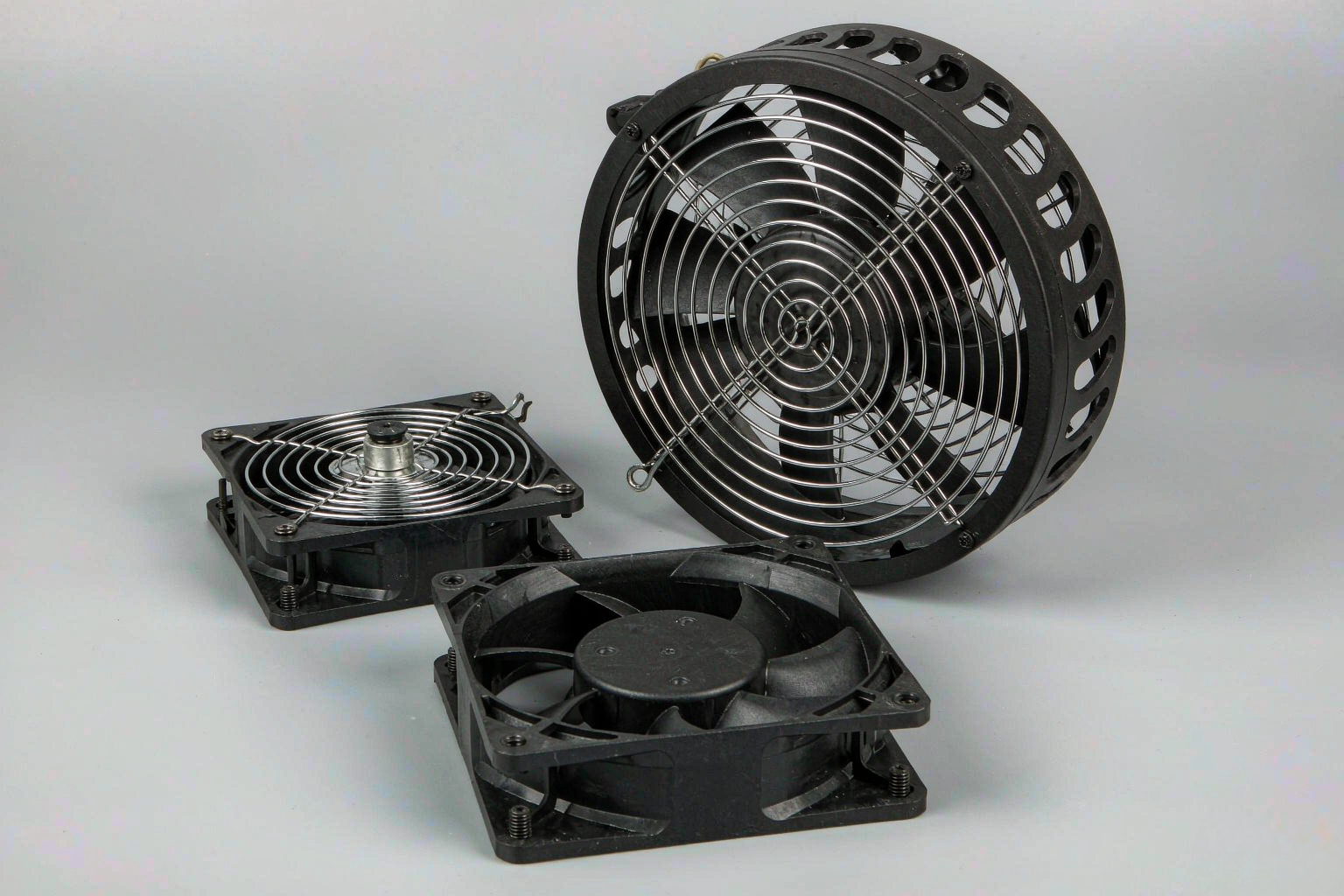
48V DC axial cooling fans integrated into a telecom power system
Quick Answer
To select a 48V DC cooling fan, verify the equipment's actual supply-voltage range, mounting space, required airflow, and system resistance. Compare model-specific airflow and static pressure, operating current, noise, and control options. Final approval should be based on the fan's P-Q curve and performance in the assembled equipment.
Key Takeaways
- Voltage compatibility comes first. A nominal 48V supply does not guarantee that every 48V-rated fan will operate correctly across the system's full voltage range.
- Airflow and static pressure must be evaluated together. Free-air CFM alone cannot predict cooling performance inside a restrictive enclosure.
- Fan size and speed affect the selection. A smaller high-speed fan may provide greater pressure capability, while a larger frame may offer different airflow and acoustic trade-offs.
- Compare exact 48V models. Current, RPM, airflow, pressure, and noise should come from the same product configuration rather than mixed series-level specifications.
- Validate the installation. Confirm thermal performance, power consumption, control compatibility, and noise under representative equipment conditions.
How Do You Choose the Right 48V DC Cooling Fan?
The most reliable approach is to begin with the equipment's operating requirements and work toward a suitable fan model.
Engineers should establish the available electrical supply, installation dimensions, cooling demand, and airflow resistance before comparing products. These conditions determine whether a specific 48V fan can perform effectively in the intended application.
Check the Actual 48V Power Supply Requirements
A fan marked 48V DC is designed around a nominal voltage rating. However, the equipment's supply may not remain at exactly 48.0V under every operating condition.
This distinction is particularly important in telecom infrastructure, where the power architecture may include battery-supported DC distribution. The actual voltage experienced by a fan can vary with the system design, charging state, operating load, and protection circuitry.
Before selecting a fan, confirm its permitted operating-voltage range rather than assuming that its nominal rating represents the minimum and maximum allowable voltages.
Also check the rated operating current, startup behavior, available power budget, and connection requirements. Where multiple fans share a power supply, the distribution circuit must accommodate their combined operating demand and applicable starting conditions.
The voltage rating alone does not establish compatibility with every telecom power bus. The manufacturer's approved electrical limits should be checked against the actual equipment design.
Match Fan Dimensions to the Equipment
Physical compatibility involves more than the outer frame dimensions.
Engineers need to verify mounting-hole positions, frame thickness, connector clearance, cable routing, inlet space, and the direction of airflow through the assembly.
For example, a 60x60x38mm fan and an 80x80x38mm fan occupy different installation footprints, even though both have a 38mm frame depth.
A smaller fan may fit a narrow cooling passage or concentrated heat-sink assembly, while a larger fan may be suitable for equipment with a wider airflow path.
Neither configuration is automatically superior.
The choice depends on the available opening, required operating airflow, system pressure resistance, and acceptable noise level.
Fan placement is equally important. Restrictive grilles, nearby structural components, or insufficient inlet clearance can alter the installed airflow and acoustic performance.
Select Airflow and Static Pressure Together
Airflow indicates the volume of air a fan can move, commonly expressed in cubic feet per minute (CFM). Static pressure describes the fan's ability to overcome resistance to airflow.
Both specifications matter, but they represent different operating conditions.
A fan's published maximum airflow is generally associated with low system resistance. Its maximum static pressure occurs near a highly restricted-flow condition.
Maximum airflow and maximum static pressure should not be interpreted as values available simultaneously at one operating point.
In an actual equipment enclosure, filters, heat-sink fins, cable arrangements, ventilation openings, and internal partitions create airflow resistance.
The appropriate fan is therefore one whose pressure–airflow (P-Q) curve can meet the required airflow at the equipment's system resistance.
For example, a fan may have an attractive free-air CFM rating but fail to maintain sufficient airflow through a dense heat sink. Another model with a lower maximum airflow rating may perform better at the required operating pressure.
A practical selection process can be organized as follows:
Once these conditions are defined, model comparison becomes more meaningful than choosing the fan with the highest advertised RPM or CFM.

Schematic fan P-Q curve and system resistance curve intersecting at the operating point (illustration, not measured test data)
Which 48V DC Fan Specifications Matter Most?
When comparing 48V cooling fans from different manufacturers, engineers should use equivalent specification categories and confirm the test conditions behind each value.
Models with the same frame size and voltage may operate at different rotational speeds, draw different amounts of current, and generate different levels of airflow and pressure.
Airflow, Pressure and Fan Speed Are Related—but Not Interchangeable
Higher rotational speed can increase airflow and static pressure within a fan design, but it can also increase acoustic noise and electrical demand.
The actual outcome depends on the fan's motor, impeller geometry, frame configuration, and operating conditions.
Therefore, engineers should avoid comparing different products solely on the basis of RPM.
A 48V fan operating at 15,000 RPM is not necessarily a better choice than a 7,500 RPM model. The higher-speed product may be suitable for a compact, highly restrictive airflow path, while the lower-speed model may better match an application requiring a wider airflow opening and lower noise.
The correct comparison depends on where the system operating point falls on each fan's P-Q curve.
Does a 48V Fan Consume Less Power Than a 24V Fan?
Not necessarily.
For equal electrical input power, a higher operating voltage corresponds to lower current:
P = V x I
This relationship can reduce resistive losses in power-distribution wiring when comparing equivalent loads. However, it does not prove that a particular 48V fan is more energy-efficient or provides greater airflow than a particular 24V fan.
Fan efficiency depends on the complete motor and aerodynamic design, operating point, and control conditions.
For an engineering comparison, use the actual input-power and cooling-performance data of the selected models. Do not assume that voltage alone determines airflow efficiency.
Comparing YCCFAN 48V DC Cooling Fan Options
YCCFAN provides different DC axial fan configurations for equipment requiring compact dimensions, higher pressure capability, or larger airflow passages.
Two published product families illustrate why selecting an exact 48V model is more useful than comparing only nominal voltage or frame size.
The DC6038F 60x60x38mm high-pressure DC fan is a compact, high-speed option for installations with limited space and demanding airflow resistance.
The DC8038 80x80x38mm high-pressure DC fan provides a larger 80mm frame and several speed configurations for applications requiring different airflow, pressure, and acoustic characteristics.
Published 48V Model Specifications
The following values are taken from the individual 48V rows in YCCFAN's published product specification tables.
Values represent the published specifications for the listed model rows. Airflow and maximum static pressure are separate performance endpoints, not simultaneous operating values. Confirm final model codes, operating limits, test conditions, and current datasheets before procurement.
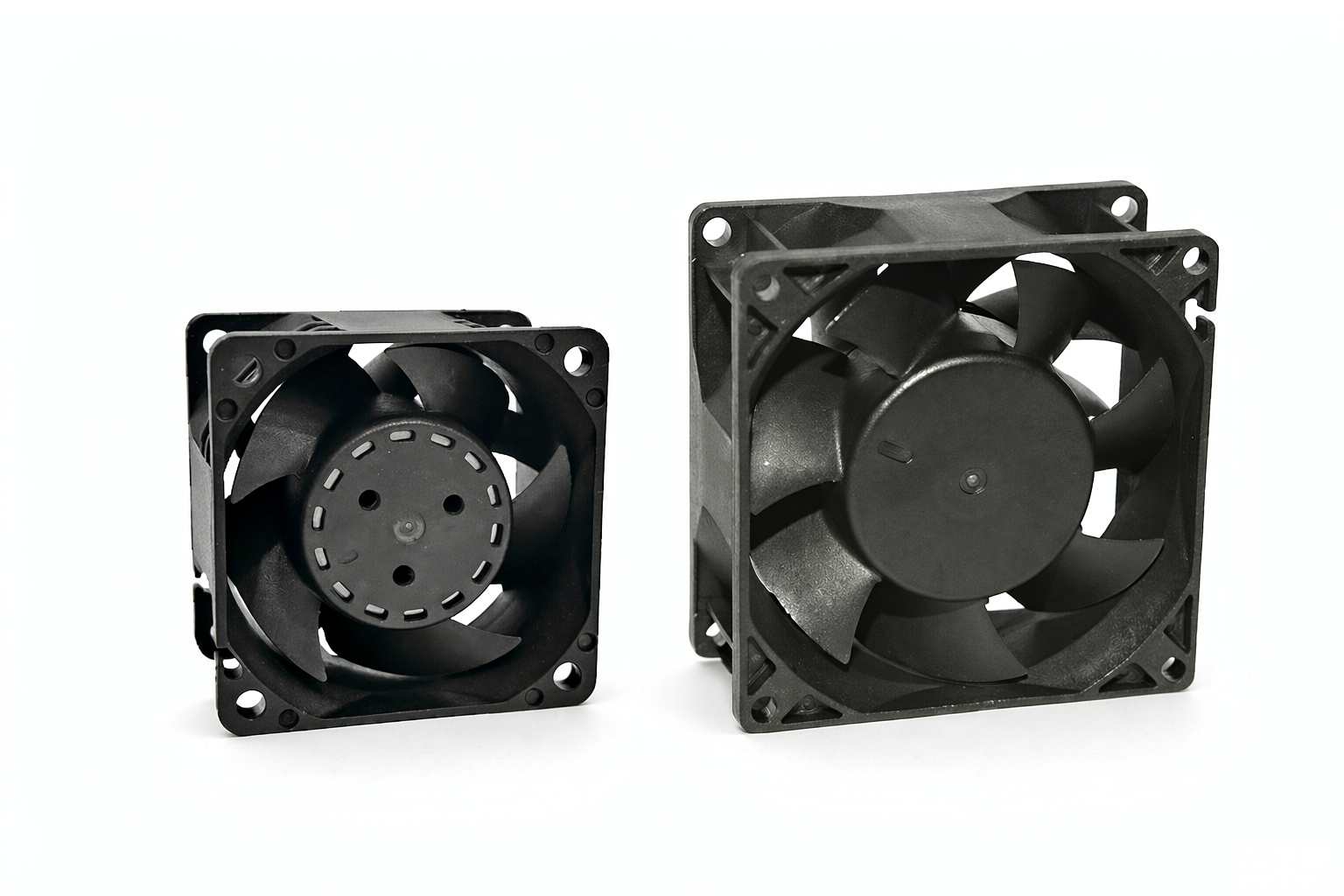
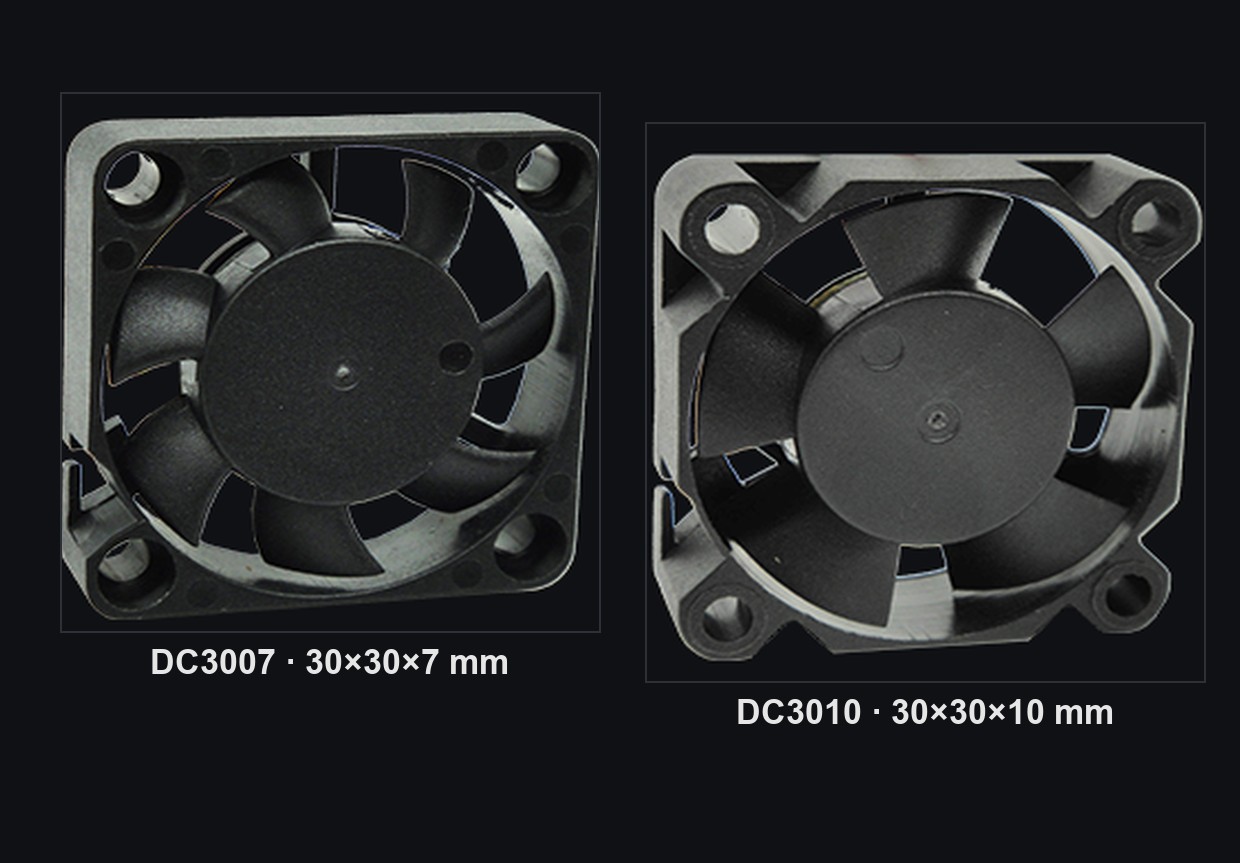
Size comparison of YCCFAN DC6038F (60 x 60 x 38 mm) and DC8038 (80 x 80 x 38 mm) 48V axial cooling fans
What Does This Comparison Reveal?
The high-speed DC6038F option illustrates how a compact 60mm fan can deliver substantial maximum static pressure. This makes the series relevant when available installation space is limited and the airflow path is restrictive.
However, its higher-speed configurations also carry significant noise and electrical-demand considerations.
The 80mm DC8038 offers a different balance. Its published 7,500 RPM configuration has a higher maximum airflow rating than the listed DC6038F models, while its maximum static pressure is lower than that of the highest-speed DC6038F.
For a system with a relatively wide airflow passage, the 80mm model may provide a suitable starting point. For a narrow passage with substantial resistance, the 60mm high-pressure design may deserve closer evaluation.
Neither conclusion should be treated as a guaranteed installed-performance result.
The final choice requires comparing the fans' actual P-Q curves against the equipment's airflow-resistance characteristics.
Noise should also be evaluated at the intended operating point. Selecting a lower-speed configuration can be helpful when the pressure and airflow requirements permit it, but a quieter model is not useful if it cannot maintain safe component temperatures.
Where Are 48V DC Fans Used in Telecom and Industrial Electronics?
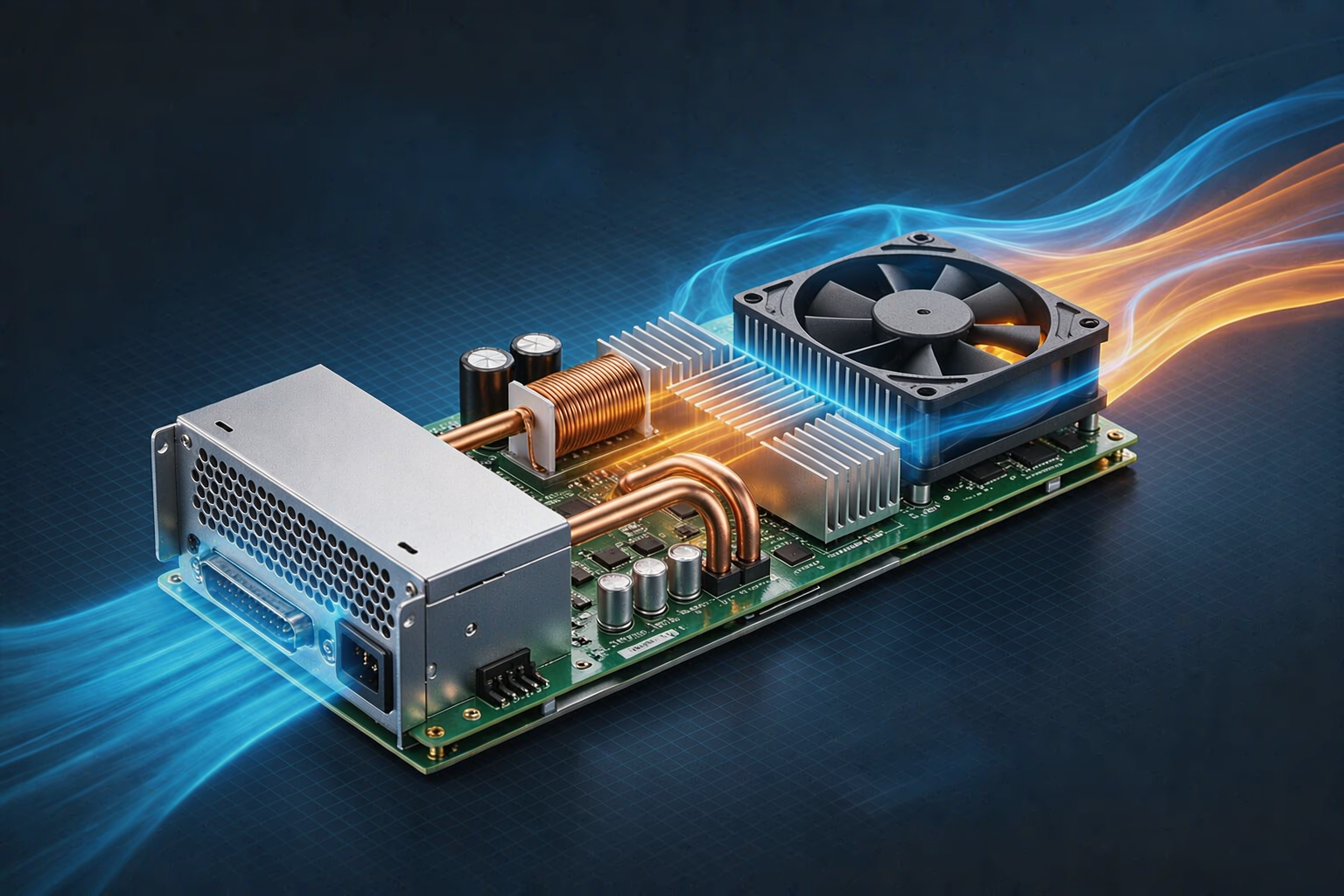
A 48V DC axial cooling fan cooling industrial power electronics
A 48V fan can be relevant wherever the equipment's power distribution and cooling architecture support that voltage.
However, different applications create different airflow demands. The electrical supply may be similar while the mechanical installation and pressure requirements vary considerably.
Telecom Power Shelves and Communication Equipment
Telecom power shelves and communication equipment may contain densely arranged power modules, electronic components, and internal cooling passages.
In equipment using a compatible 48V DC supply, a 48V cooling fan can be considered without necessarily introducing a separate fan-voltage architecture.
The important selection factors are the actual voltage range, fan installation depth, internal airflow path, continuous operating demand, and monitoring requirements.
Where the cooling air passes through dense components or narrow channels, pressure capability becomes especially important.
Engineers should also confirm whether the control system requires a particular PWM interface, speed feedback, or fault indication.
A fan with the correct voltage and dimensions may still be unsuitable if its control wiring or tachometer behavior does not match the host equipment.
Industrial Power Electronics and Inverter Cooling
Industrial power electronics often generate concentrated heat around power semiconductors, magnetic components, and associated heat sinks.
When a design uses a compatible 48V fan supply, selecting the correct fan requires evaluating the heat-sink geometry and the system's operating environment.
Dense heat-sink fins create pressure resistance, and airflow must reach the components that require cooling.
A high-speed fan may be appropriate when strong pressure capability is needed in a limited space, but the added acoustic noise and electrical demand must be considered.
For these applications, engineers should validate temperatures at critical components under representative loads rather than rely only on catalog airflow ratings.
Filtered Electronic Enclosures
Industrial electronics enclosures may use dust filters, protective grilles, or restricted ventilation openings.
These features can reduce airflow through the system and change the fan's operating point.
As a filter accumulates dust, airflow resistance may increase. A fan selected only for clean-filter conditions could eventually deliver less airflow than the equipment requires.
The selection should therefore consider the expected range of system resistance, maintenance conditions, and acceptable component temperatures.
The following table summarizes how different applications influence fan selection.
These are application-based engineering considerations rather than claims that one particular YCCFAN model is approved for every listed installation.
How Can OEM Engineers Verify a 48V Fan Before Approval?
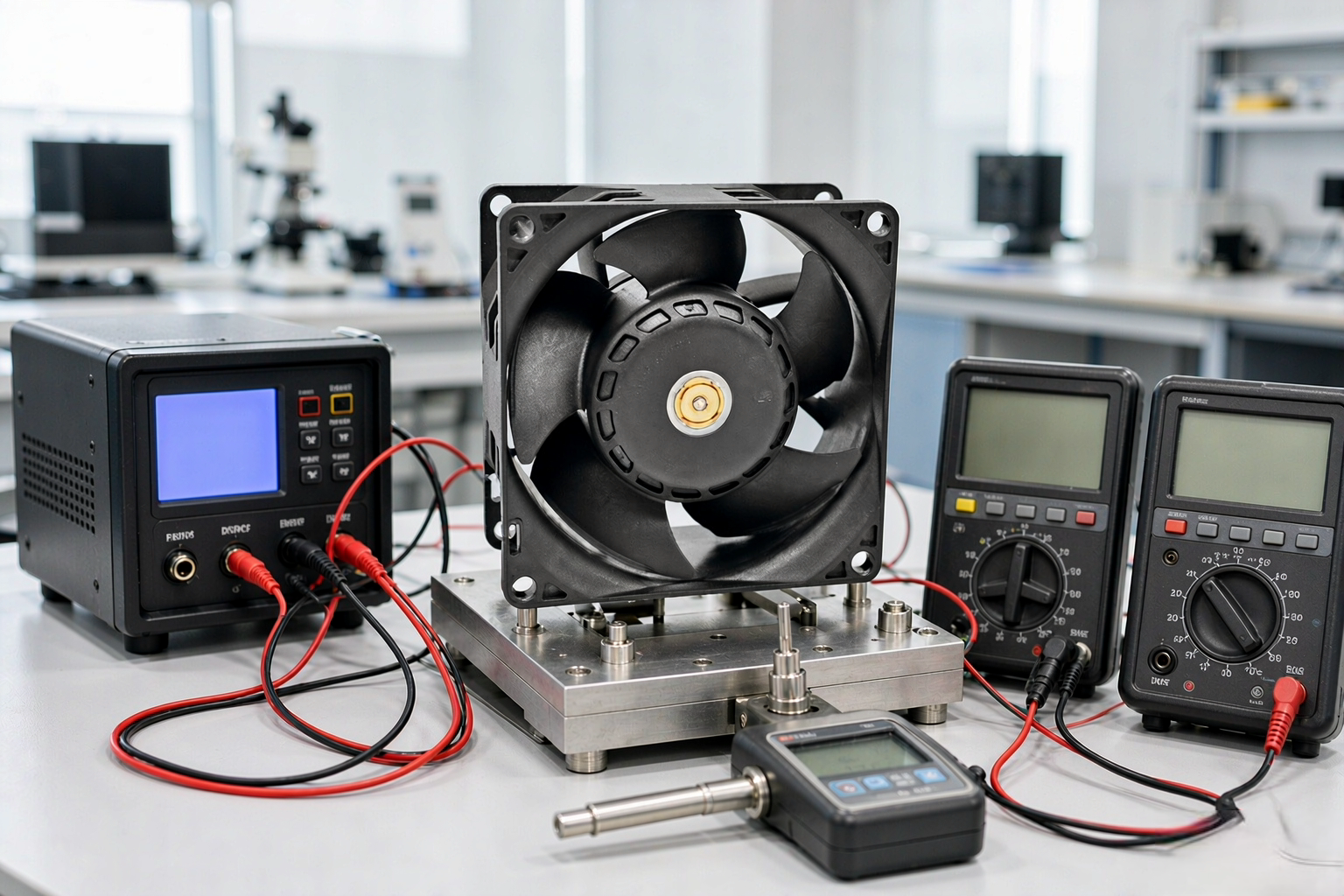
48V DC fan OEM sample verification on the test bench
Catalog specifications provide the starting point for evaluation, but OEM approval should be based on the actual equipment requirements.
A suitable 48V cooling fan must not only start and rotate; it must also maintain sufficient cooling performance when installed in the equipment.
Engineering validation should consider normal operation, startup, high-load conditions, and any relevant environmental constraints.
A fan may meet its published specifications during laboratory testing but perform differently in an assembled enclosure. This does not necessarily indicate a defective fan; the surrounding airflow resistance and installation conditions may have changed its operating point.
OEM engineers should therefore define acceptance criteria before evaluating samples.
These criteria may include maximum allowable component temperature, acceptable operating noise, electrical current limits, speed-control behavior, and expected performance across relevant system conditions.
For production approval, the selected model code, configuration and validation results should be documented so that later orders match the qualified design.
Where Can OEM Buyers Source Reliable 48V DC Fans?
For industrial applications, a reliable 48V DC fan supplier should provide more than a nominal voltage rating and a maximum airflow figure.
OEM buyers need enough technical information to determine whether the proposed fan fits the equipment, meets the thermal requirement, and can be consistently specified for procurement.
A useful supplier evaluation should focus on four areas.
Model-specific technical data. Confirm the complete fan model code, dimensional drawing, rated voltage, current, RPM, airflow, static pressure, noise, and bearing configuration.
Performance evidence. Request the relevant P-Q curve and the test conditions associated with performance values. When comparing alternative models, ensure that the measurement conditions are compatible.
Electrical and mechanical configuration. Verify cable length, connector arrangement, pin assignment, and any optional PWM, FG or RD features required by the equipment.
Sample approval and production consistency. Establish the approved configuration and acceptance criteria before moving from engineering samples to production orders.
For example, a buyer looking for a compact, high-pressure 48V axial fan can review YCCFAN's DC6038F series, while an application requiring an 80mm installation frame can begin with the DC8038 series.
The correct choice depends on the thermal design rather than the product name alone.
For custom OEM requirements, buyers should communicate the operating voltage range, installation dimensions, expected airflow and resistance, ambient conditions, control interface, estimated order quantities, and any specific testing requirements.
These details allow the manufacturer to evaluate suitable configurations without making assumptions about the equipment.
FAQs About 48V DC Cooling Fan Selection
Can a 48V DC fan operate directly from a telecom power system?
A 48V-rated fan may be suitable for a telecom system using compatible DC power distribution, but the complete operating-voltage range must be checked. A nominal 48V rating does not guarantee compatibility with every telecom bus condition, including voltage variations and transients.
Does a 48V fan provide more airflow than a 24V fan?
Not automatically. Airflow depends on the fan design, rotational speed, pressure–airflow characteristics, and operating conditions. The rated voltage does not determine cooling performance by itself. Compare the published specifications and P-Q curves of the specific 24V and 48V models.
Do 48V DC cooling fans support PWM speed control and FG feedback?
Some 48V DC fan models offer PWM control, FG speed feedback, or RD alarm functions. These features are not universal. Their availability, wiring arrangement, signal characteristics, and compatibility must be confirmed for the exact product configuration.
What information should I provide when requesting a 48V DC fan sample?
Provide the required frame size, operating-voltage range, airflow and static-pressure requirements, installation conditions, electrical connector, speed-control or monitoring needs, acoustic limits, and expected application. A dimensional drawing or equipment airflow description can help clarify the selection.
Conclusion
Selecting a 48V DC cooling fan for telecom or industrial electronics requires more than matching the voltage printed on the product label.
The right model must fit the installation, operate within the equipment's actual electrical limits, and provide sufficient airflow at the required system pressure. Comparing exact specifications, rather than series-level maximum values, makes the selection more reliable.
YCCFAN's DC6038F and DC8038 series offer different frame sizes, speed configurations, and airflow-pressure characteristics for OEM evaluation.
For a new cooling project, sharing the equipment's power, mechanical, thermal, and control requirements helps identify a suitable 48V fan configuration and establish the conditions for sample approval.