





40mm vs 50mm vs 80mm 24V DC Cooling Fans: Which Size Fits Your Equipment?
Selecting a 24V DC cooling fan involves more than choosing a frame that fits inside an electronic enclosure. A 40mm fan, a 50mm fan, and an 80mm fan can behave very differently, even when they operate at the same nominal voltage.
Smaller fans are often associated with compact installations, while larger fans are commonly chosen when greater airflow is required. However, size alone does not determine cooling performance. A deep-frame 40mm fan designed for high static pressure may handle a restrictive airflow path differently from a thin 80mm fan intended for a wider ventilation opening.
For OEM engineers, the decision depends on mounting space, available installation depth, airflow resistance, noise limits, and the cooling requirements of the actual equipment.
This guide compares 40mm, 50mm, and 80mm 24V DC cooling fans using published YCCFAN model specifications to explain where each size offers advantages and what engineers should verify before approving a design.
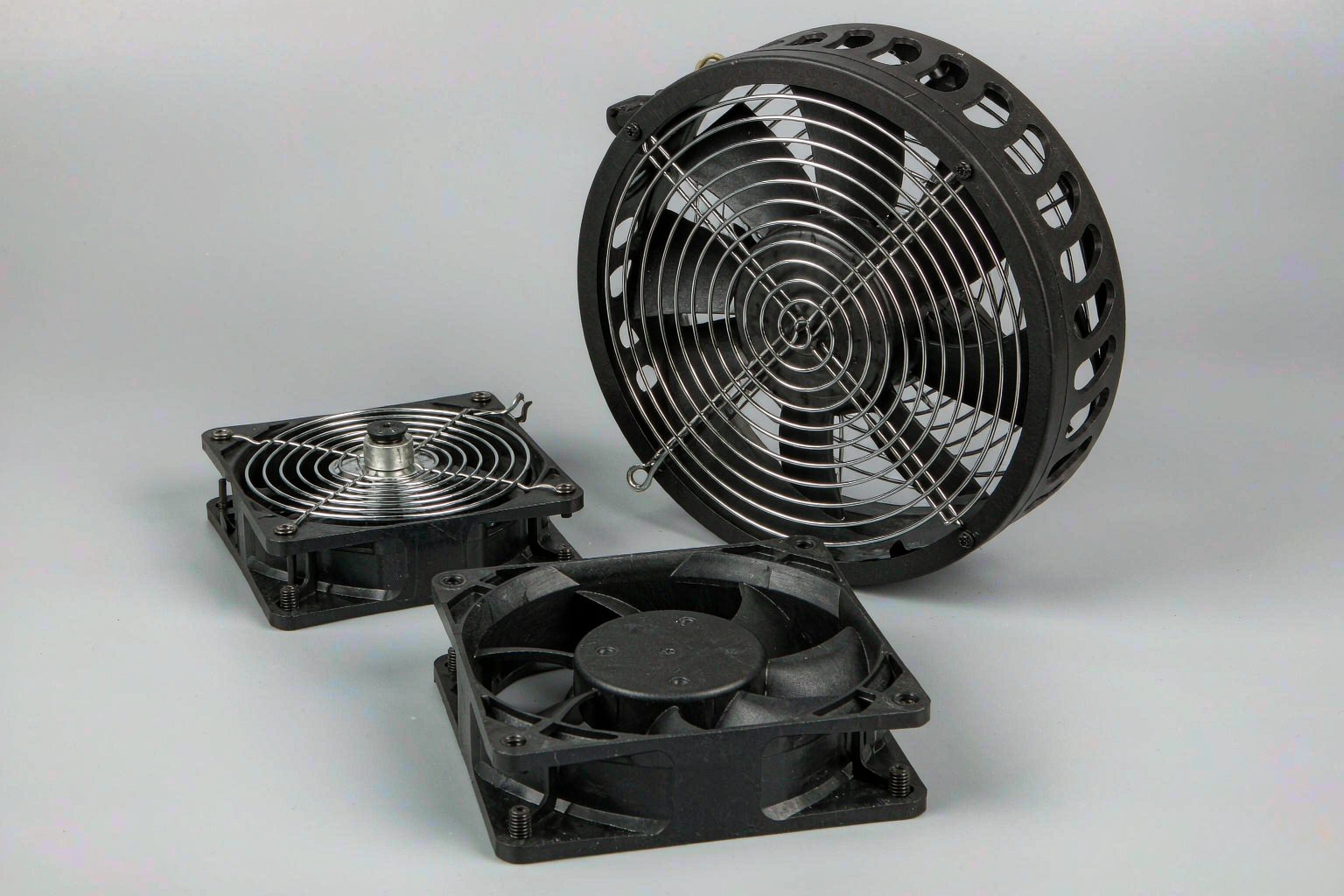
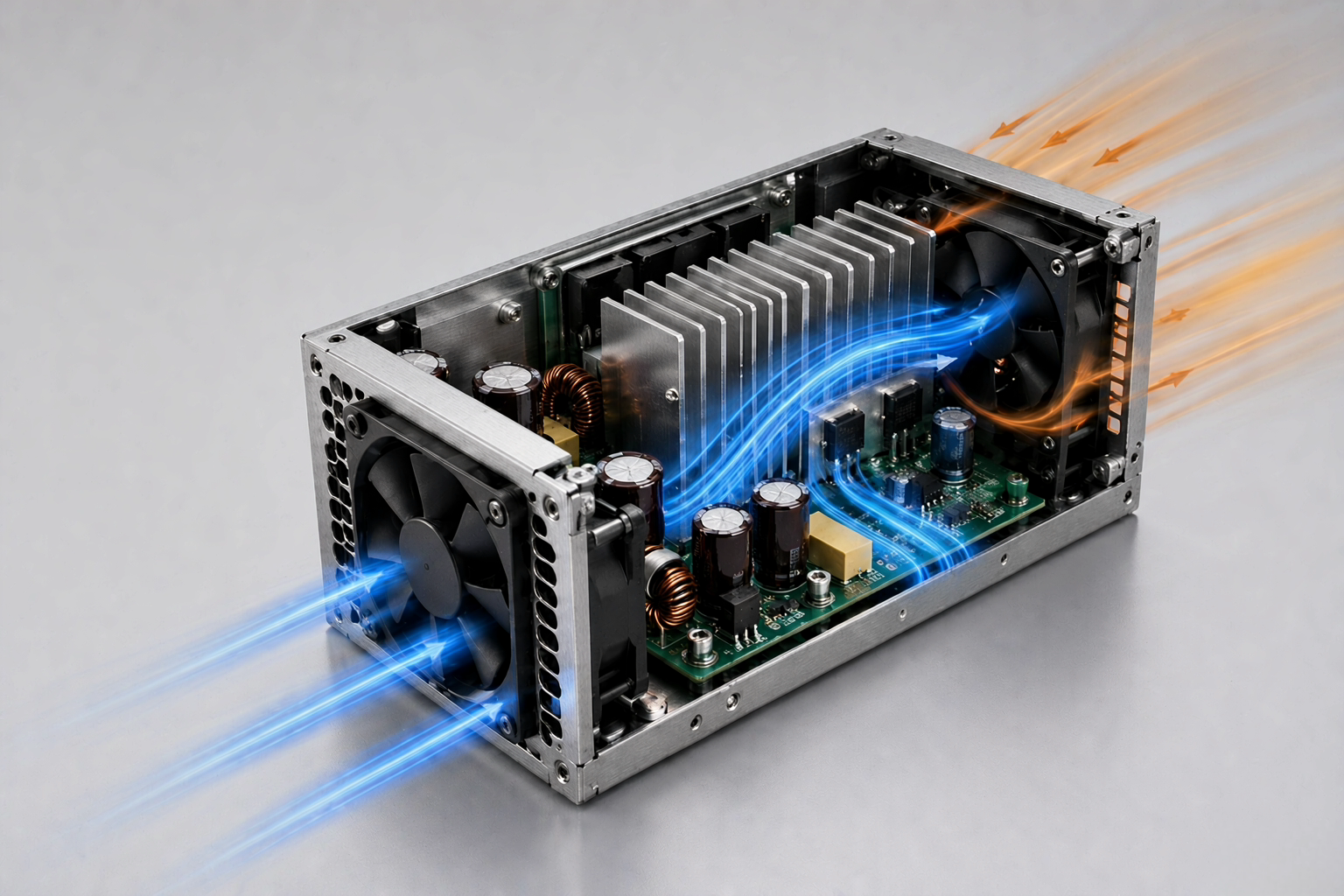
40mm, 50mm and 80mm 24V DC axial cooling fans used in electronics cooling
Quick Answer
Choose a 40mm, 50mm, or 80mm 24V DC fan according to available mounting space, required airflow, static pressure, and noise limits. A larger fan generally offers a larger airflow opening, but a compact high-pressure fan may be more suitable for restrictive cooling paths. Compare exact models and validate installed performance.
Key Takeaways
- Frame size is only the starting point. Installation depth, inlet clearance, and internal airflow paths can be just as important as the fan's width and height.
- A smaller fan can produce higher static pressure. YCCFAN's 40x40x28mm DC4028G demonstrates why fan design and speed matter alongside frame size.
- 50mm fans offer another installation option. A 50x50x20mm configuration may suit equipment that cannot accommodate an 80mm frame but needs more airflow than a thin 40mm model provides.
- 80mm fans offer different airflow and depth choices. The DC8015 and DC8020 illustrate how changing fan thickness and speed affects published performance.
- Actual cooling depends on the operating point. Maximum airflow and maximum static pressure should never be treated as simultaneous performance values.
How Do You Choose Between 40mm, 50mm and 80mm DC Cooling Fans?
When selecting a fan for 24V-powered equipment, engineers should first establish the available mounting area and the airflow requirements of the cooling system.
A 40mm 24V fan may fit a compact power supply, communication module, or densely packaged electronic assembly. An 80mm 24V fan requires a larger mounting opening but can offer greater airflow capacity in a broader ventilation path.
A 50mm DC fan provides another frame size for designs that fall between those installation constraints.
However, the mounting opening does not tell the whole story.
The thickness of the fan influences installation clearance and may be associated with substantial differences in motor and aerodynamic design. Two 40mm fans with depths of 10mm and 28mm should not be expected to deliver comparable pressure or noise characteristics.
Similarly, an 80x80x15mm fan and an 80x80x20mm fan share the same nominal face dimensions but may be suited to different operating conditions.
Start With the Equipment's Physical Constraints
Before comparing airflow ratings, establish the following information:
| Equipment requirement | Selection question | Why it matters |
|---|---|---|
| Mounting opening | Does the design accept a 40mm, 50mm, or 80mm frame? | Determines basic mechanical compatibility |
| Available depth | Can the equipment accommodate 10mm, 15mm, 20mm, or 28mm thickness? | Limits suitable fan constructions |
| Airflow path | Does air pass through a narrow duct, dense heat sink, or open enclosure? | Influences required static pressure |
| Cooling demand | How much airflow is needed under actual system resistance? | Defines the operating performance target |
| Power supply | Is the supply compatible with the exact 24V model? | Ensures electrical compatibility |
| Noise requirement | What noise level is acceptable in the installed equipment? | Helps select speed and fan configuration |
For an existing equipment design, the mounting dimensions may already be fixed. In that case, engineers should compare different speed and thickness options within the permitted space.
For new equipment, fan selection can also inform the enclosure design. Allowing sufficient inlet and outlet area may reduce airflow resistance and broaden the range of suitable cooling fans.
Comparing YCCFAN 24V Fan Specifications Across Three Sizes
YCCFAN offers several 24V DC axial fan models across 40mm, 50mm, and 80mm frame sizes.
The following comparison uses specific 24V model rows rather than combining the highest performance values from different voltage or speed configurations.
| YCCFAN model | Dimensions | Current | Speed | Airflow | Max. static pressure | Noise |
|---|---|---|---|---|---|---|
| YDH4010X24F | 40x40x10mm | 0.03 A | 8,000 RPM | 8.80 CFM | 5.39 mmH2O | 31.10 dBA |
| YDH4028B24G | 40x40x28mm | 0.17 A | 13,000 RPM | 15.85 CFM | 26.22 mmH2O | 47.50 dBA |
| YDD5020X24 | 50x50x20mm | 0.15 A | 7,500 RPM | 22.78 CFM | 10.35 mmH2O | 41.60 dBA |
| YDH8015X24F | 80x80x15mm | 0.26 A | 4,000 RPM | 46.47 CFM | 4.55 mmH2O | 36.30 dBA |
| YDD8020X24F | 80x80x20mm | 0.19 A | 5,500 RPM | 53.94 CFM | 8.95 mmH2O | 46.61 dBA |
Source: Published YCCFAN specifications for the listed 24V variants. Maximum airflow and maximum static pressure represent different test conditions. Actual airflow must be determined from the relevant P-Q curve and system resistance. Acoustic values should be compared with their respective test conditions in mind.
This comparison shows that increasing frame size does not produce a uniform increase in every performance parameter.
The 80mm models offer greater published maximum airflow than the listed 40mm and 50mm configurations. However, the 40mm DC4028G has the highest maximum static pressure among these five specific models.
Noise also varies considerably. The 40x40x10mm DC4010F has a lower published noise rating than the deeper 40mm DC4028G, but it also has substantially lower airflow and static pressure ratings.
These trade-offs make model-specific selection more meaningful than judging performance by fan dimensions alone.
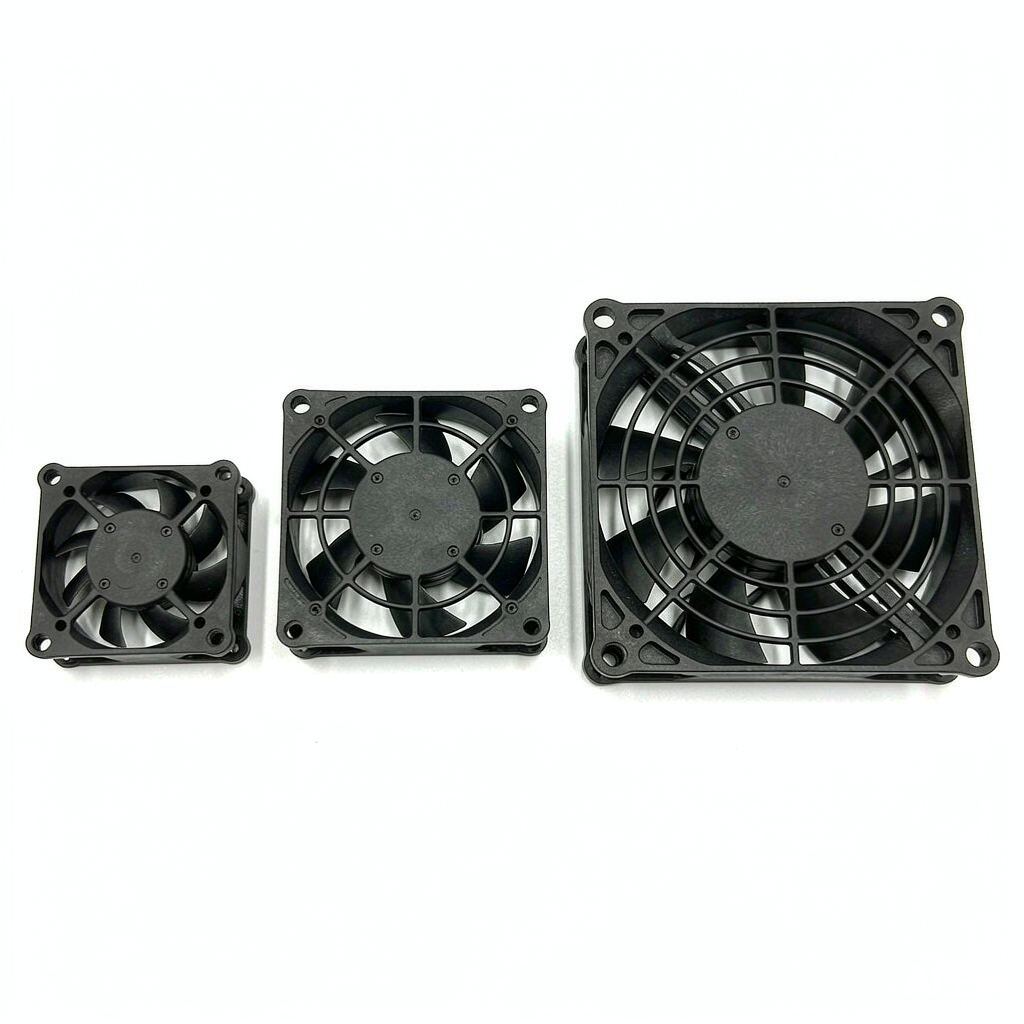
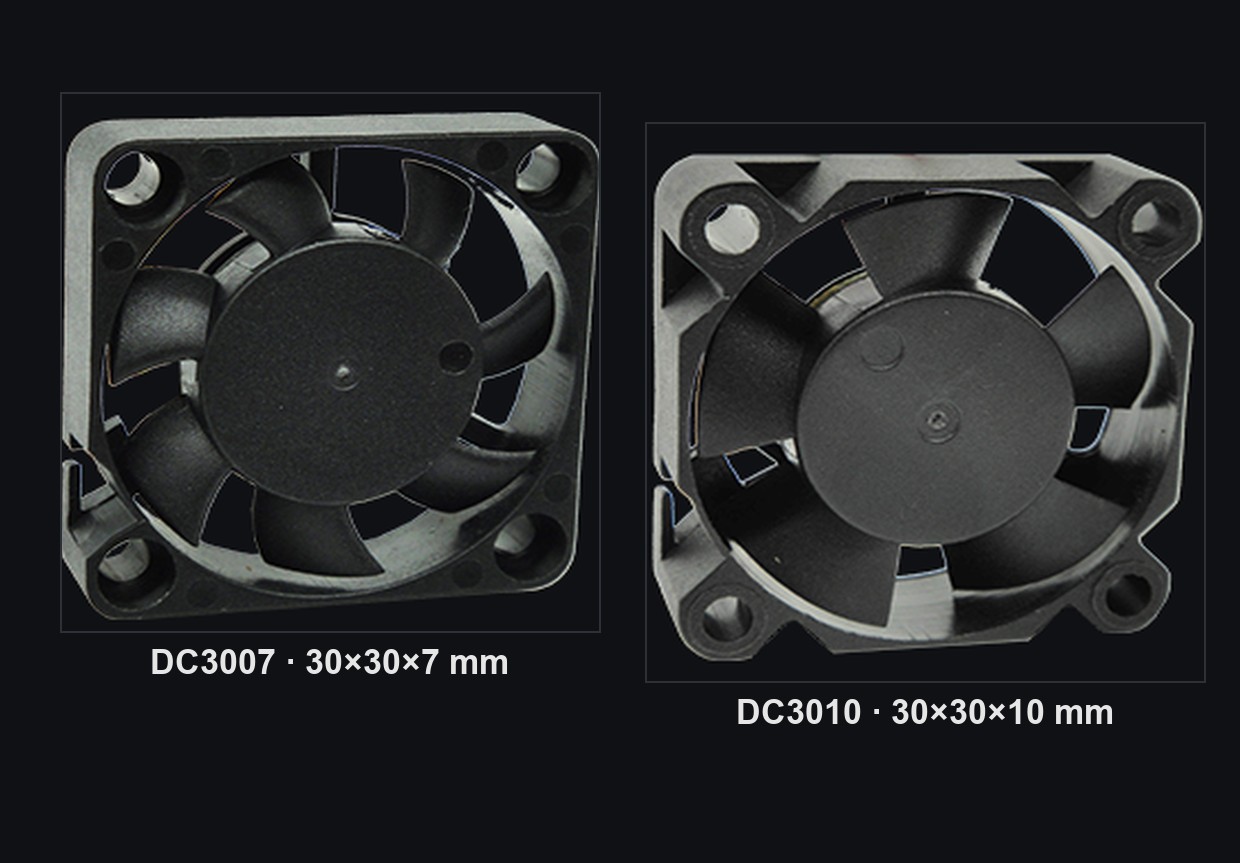
Relative size comparison of 40mm, 50mm and 80mm 24V DC axial cooling fans (illustration)
40mm 24V Fans: Compact Frames and High-Pressure Alternatives
A 40mm 24V fan is often considered when a design has a limited mounting footprint.
However, the 40mm category includes different depth and performance configurations.
YCCFAN's DC4010F 40x40x10mm DC cooling fan provides a thin-frame option for compact installations.
Its YDH4010X24F model has a published maximum airflow of 8.80 CFM, maximum static pressure of 5.39 mmH2O, and noise level of 31.10 dBA.
The 10mm frame depth can be relevant where the equipment has limited clearance behind the mounting surface. Applications may include small power electronics, compact network devices, or appliance enclosures with matching cooling requirements.
By comparison, the DC4028G 40x40x28mm high-pressure DC fan takes a different approach.
Its YDH4028B24G configuration operates at 13,000 RPM and provides published maximum airflow of 15.85 CFM and maximum static pressure of 26.22 mmH2O.
The deeper frame and higher-pressure design make it a candidate for compact systems containing dense heat-sink fins, restrictive grilles, or narrow forced-air passages.
The difference between these two models demonstrates an important selection principle: two fans with the same 40mm mounting footprint can have substantially different pressure, noise, and installation-depth characteristics.
A higher-pressure 40mm design may be worth evaluating when a thin fan cannot maintain enough airflow through the equipment. However, the deeper construction must fit the available space, and the higher noise level must be acceptable.
50mm DC Fans: A Middle Ground in Mounting Size
A 50mm DC fan can be considered when a 40mm mounting opening is too restrictive but an 80mm fan cannot fit.
YCCFAN's DC5020 50x50x20mm DC cooling fan includes a 24V high-output configuration.
The YDD5020X24 model operates at 7,500 RPM, with published maximum airflow of 22.78 CFM and maximum static pressure of 10.35 mmH2O.
Its 20mm frame depth should also be considered during mechanical design.
For equipment with a medium-sized opening, this model offers a different airflow-pressure combination from the 40mm alternatives.
Compared with the listed thin DC4010F, the DC5020 provides higher published airflow and maximum static pressure, although it requires a larger mounting footprint and greater depth.
Compared with the high-pressure DC4028G, it provides higher published maximum airflow but lower maximum static pressure.
These differences may make the 50mm option worth testing where a design needs more airflow than a thin 40mm fan can supply but does not require the same peak-pressure capability as a specialized deep-frame 40mm fan.
It is not, however, a universal compromise between two fan sizes. The equipment's actual system resistance determines whether this combination is suitable.
80mm 24V Fans: Higher Airflow With Different Depth Options
An 80mm 24V fan provides a larger mounting format that can be useful when the equipment has a wider inlet or exhaust opening.
The DC8015 80x80x15mm DC fan is designed for equipment with an 80mm opening but limited available installation depth.
Its YDH8015X24F model has a published maximum airflow of 46.47 CFM and maximum static pressure of 4.55 mmH2O at 4,000 RPM.
The DC8020 80x80x20mm DC fan uses a thicker 20mm frame.
Its YDD8020X24F model operates at 5,500 RPM, with maximum airflow of 53.94 CFM and maximum static pressure of 8.95 mmH2O.
The two models demonstrate why depth and speed must be considered even after the 80mm frame size has been selected.
The DC8015 offers a thinner construction and a lower published noise rating in the compared configurations. The DC8020 provides higher published airflow and maximum pressure, but its listed noise level is also higher.
For a relatively open ventilation path, the thinner option may be a suitable candidate if it meets the cooling requirement.
Where the system has greater resistance and enough installation depth, the DC8020 may be worth evaluating.
In both cases, the final selection should be based on airflow at the required operating pressure, not simply the catalog maximum airflow.
Is a Larger DC Fan Always Better for Airflow and Static Pressure?
A larger fan is not automatically better in every cooling system.
Fan size influences the available airflow opening, but performance also depends on impeller geometry, motor design, rotational speed, frame depth, and the resistance of the equipment.
The published YCCFAN models illustrate this clearly.
Among the five compared 24V configurations, the DC4028G has the highest maximum static pressure, despite having the smallest frame width.
The DC8020 has the highest published maximum airflow, but its maximum static pressure is lower than that of the high-pressure DC4028G configuration.
This does not mean the DC4028G will always outperform the DC8020 in a restrictive enclosure. Their complete P-Q curves must be compared at the relevant system resistance.
Why Maximum Airflow and Maximum Pressure Are Not Enough
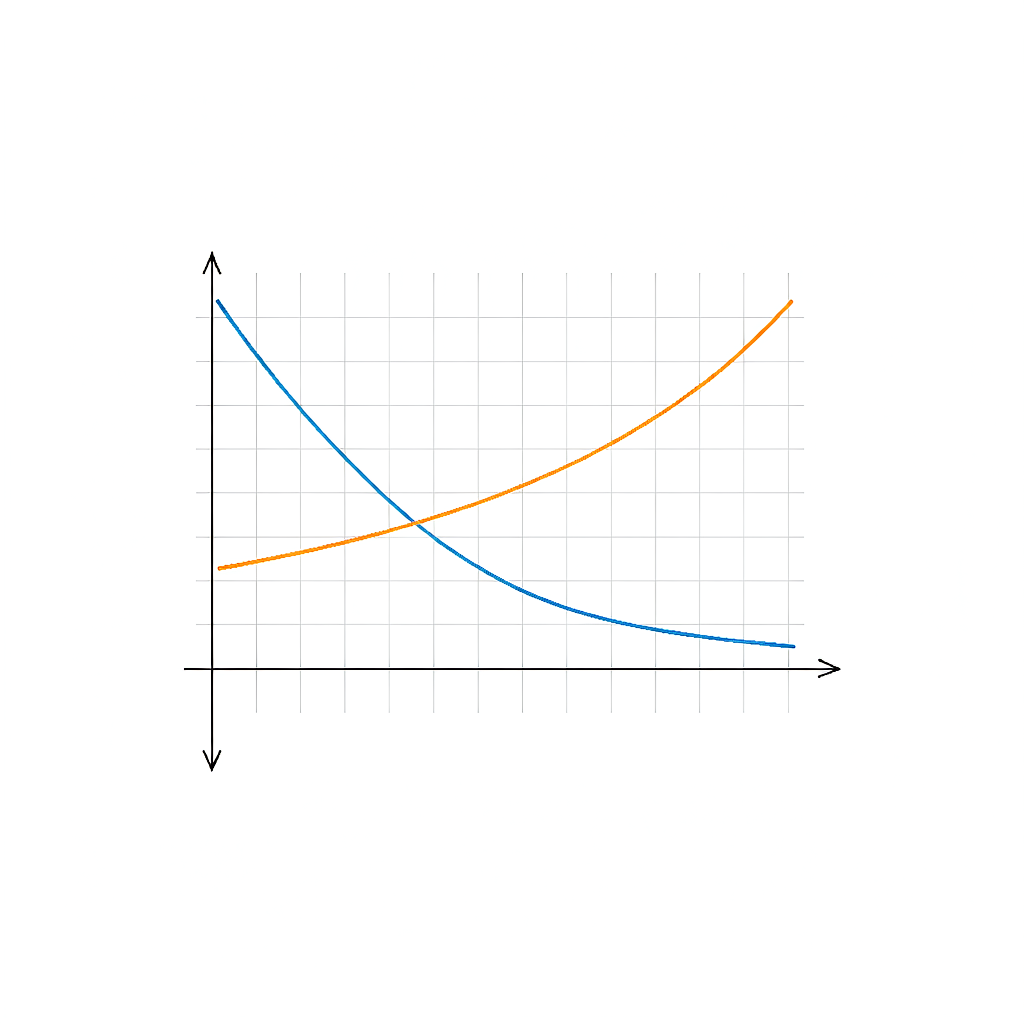
A fan P-Q curve intersecting the system resistance curve at the operating point (illustration)
A fan's operating point is determined by the intersection of its P-Q curve and the system resistance curve.
At low resistance, airflow tends to be higher. As resistance increases, the fan generally delivers less airflow.
This becomes especially important in equipment containing closely spaced components, protective grilles, dust filters, or dense heat sinks.
For example, a fan with a high free-air CFM value may lose substantial airflow as resistance increases. A smaller high-pressure design may maintain a more useful operating point for a particular restrictive path.
However, that result cannot be confirmed from maximum airflow and maximum pressure specifications alone.
Without comparable P-Q data at the desired operating pressure, engineers should treat any performance ranking as provisional.
Three Practical Comparison Scenarios
| Equipment condition | Selection priority | Models worth evaluating |
|---|---|---|
| Very limited frame depth | Thin construction and acceptable airflow | DC4010F or DC8015, depending on opening size |
| Small opening with substantial resistance | Pressure capability within a compact footprint | DC4028G |
| Wide ventilation opening with higher airflow demand | Operating airflow, pressure and noise balance | DC8015 or DC8020 |
These are starting points for engineering evaluation, not fixed application recommendations.
A larger fan may be preferable when it fits the equipment and provides the required airflow at lower acceptable noise. A smaller fan may be preferable when installation space is restricted or when a particular high-pressure design better matches the airflow path.
The correct answer always depends on the completed system.
Which 24V Fan Size Is Suitable for Different Electronics Enclosures?
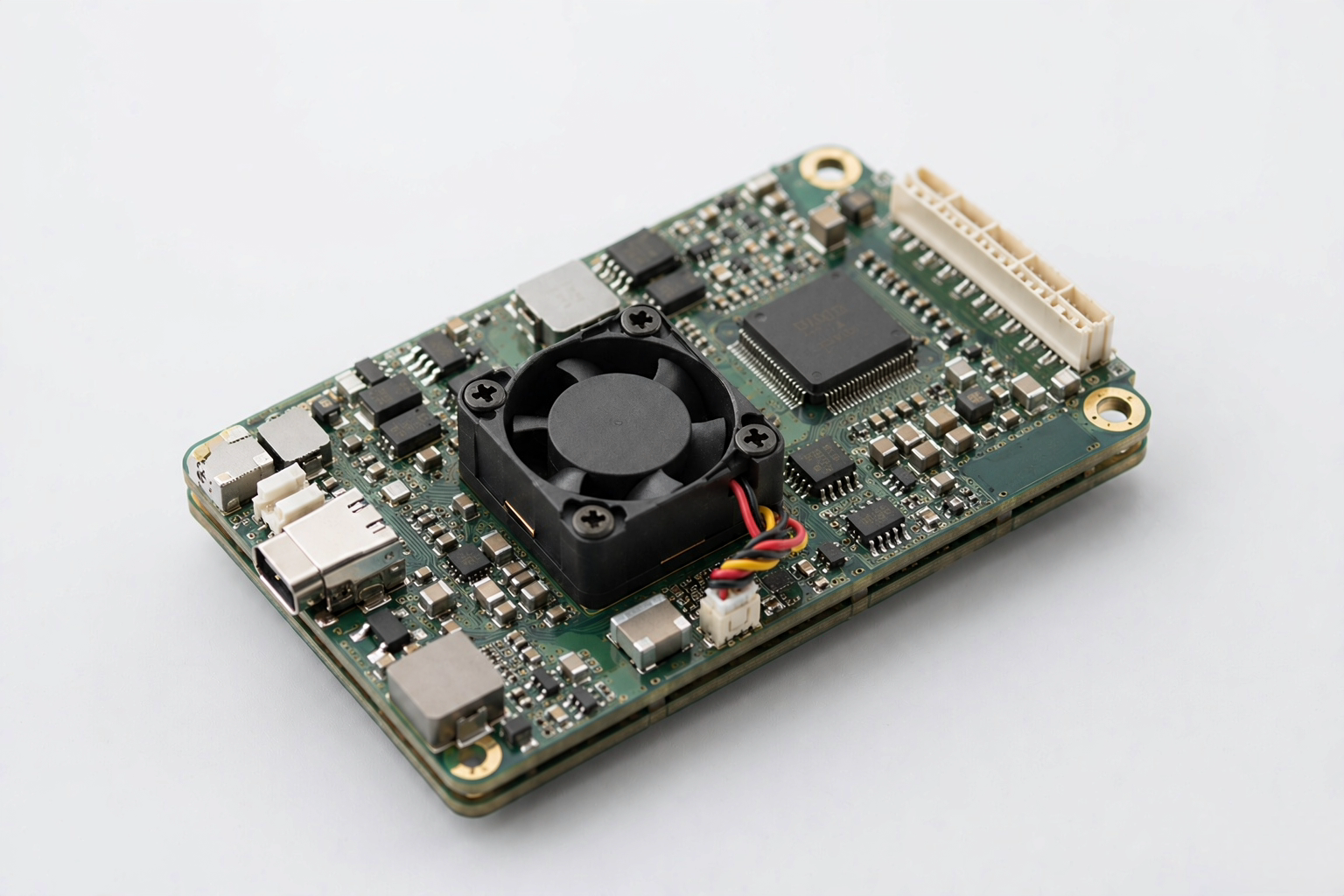
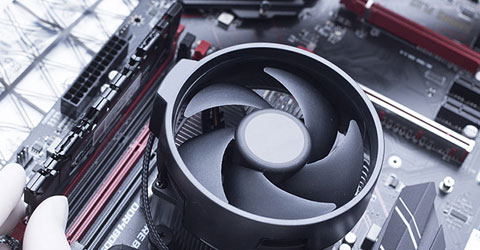
A 24V DC axial cooling fan cooling a compact electronic device
Different electronic enclosures create different mechanical and airflow constraints.
Rather than assigning one fan size to an entire industry, engineers should identify the actual characteristics of the equipment.
Compact Power Supplies and Small Electronic Modules
Small power supplies and embedded electronic modules may allow only a narrow fan opening or limited installation depth.
Where a 40mm mounting format is required, the DC4010F can be evaluated when the thinner construction and its airflow-pressure performance meet the equipment requirements.
If the same 40mm mounting footprint must serve a more restrictive internal airflow path, the deeper DC4028G may offer an alternative, provided the enclosure has sufficient depth.
A 50mm frame should also be considered when the enclosure design can accommodate a larger opening.
Dense Heat Sinks and Restricted Airflow Channels
Equipment containing dense heat-sink fins or narrow internal ducts can impose significant airflow resistance.
In these cases, selecting the fan with the highest free-air CFM is not necessarily the best approach.
The high-pressure DC4028G and the DC5020 provide different performance options for compact designs, but their actual suitability must be confirmed using the required operating airflow and resistance.
Engineers should also evaluate acoustic noise, electrical load, and the temperature of the components being cooled.
Electronic Control Cabinets and Communication Equipment
Enclosures with a wider mounting area may accommodate an 80mm fan.
For shallow installations, the 15mm-deep DC8015 may be a practical candidate. Where 20mm depth is available and the cooling demand is greater, the DC8020 provides additional performance options.
However, the airflow path must remain compatible with the fan's operating characteristics.
Filters, protective panels, cable bundles, or dense electronic assemblies may increase resistance and reduce installed airflow.
The table below summarizes the selection approach.
| Equipment constraint | Initial fan direction | Important verification |
|---|---|---|
| 40mm opening and minimal depth | DC4010F | Airflow and temperature within limited depth |
| 40mm opening and restrictive internal path | DC4028G | P-Q performance, depth, current and noise |
| 50mm opening and moderate-to-higher cooling demand | DC5020 | Operating airflow at actual resistance |
| 80mm opening with shallow depth | DC8015 | Cooling adequacy and acoustic performance |
| 80mm opening with 20mm depth available | DC8020 | Thermal benefit versus current and noise |
The preferred model should be selected only after its specified characteristics are matched with the equipment's mechanical and thermal requirements.
How Should OEM Engineers Compare Noise, Power and Cooling Performance?
Airflow, pressure, power consumption, and noise are interconnected selection considerations.
A higher-speed fan may provide greater airflow and static pressure, but it may also draw more current and produce more noise.
The exact relationship depends on the specific motor and impeller design.
For this reason, engineers should avoid constructing an unrealistic ideal specification by combining the lowest noise, highest airflow, and highest static pressure figures from different models.
Instead, compare complete configurations under the intended operating conditions.
Compare Electrical Demand Using the Exact Model
For a DC fan, nominal electrical input power can be estimated from voltage and current:
Input power (W) = Voltage (V) x Current (A)
Using the published rated current for the compared 24V models gives the following nominal values:
| Model | Rated current | Calculated nominal input power |
|---|---|---|
| YDH4010X24F | 0.03 A | 0.72 W |
| YDH4028B24G | 0.17 A | 4.08 W |
| YDD5020X24 | 0.15 A | 3.60 W |
| YDH8015X24F | 0.26 A | 6.24 W |
| YDD8020X24F | 0.19 A | 4.56 W |
Calculated from 24V nominal voltage and the published model currents. These figures are not measured whole-system power consumption or motor-efficiency ratings.
This comparison illustrates why fan size should not be used as a substitute for checking actual electrical requirements.
The listed 80mm DC8015 configuration has a higher calculated nominal input power than the compared DC8020 configuration, despite operating at a lower rotational speed. Different fan constructions and motor designs can produce different electrical characteristics.
Similarly, the high-pressure 40mm DC4028G requires more nominal power than the thin DC4010F configuration.
Whether the additional electrical demand is justified depends on the cooling benefit achieved in the actual system.
Evaluate Noise Together With the Required Cooling Performance
Noise should be evaluated under comparable conditions and at the speed needed to meet the cooling requirement.
A low-noise fan may be attractive for office electronics or other noise-sensitive equipment, but it must still maintain acceptable internal temperatures.
A high-pressure fan may be appropriate for densely packaged electronics, even if its published sound level is higher.
Where speed control is required, engineers should confirm the available PWM or other control configuration for the selected model rather than assuming that every fan supports the same control method.
Ultimately, the design target is not the quietest fan or the fastest fan. It is the fan configuration that satisfies the thermal, electrical, mechanical, and acoustic requirements together.
How to Validate a 24V DC Fan Before OEM Approval
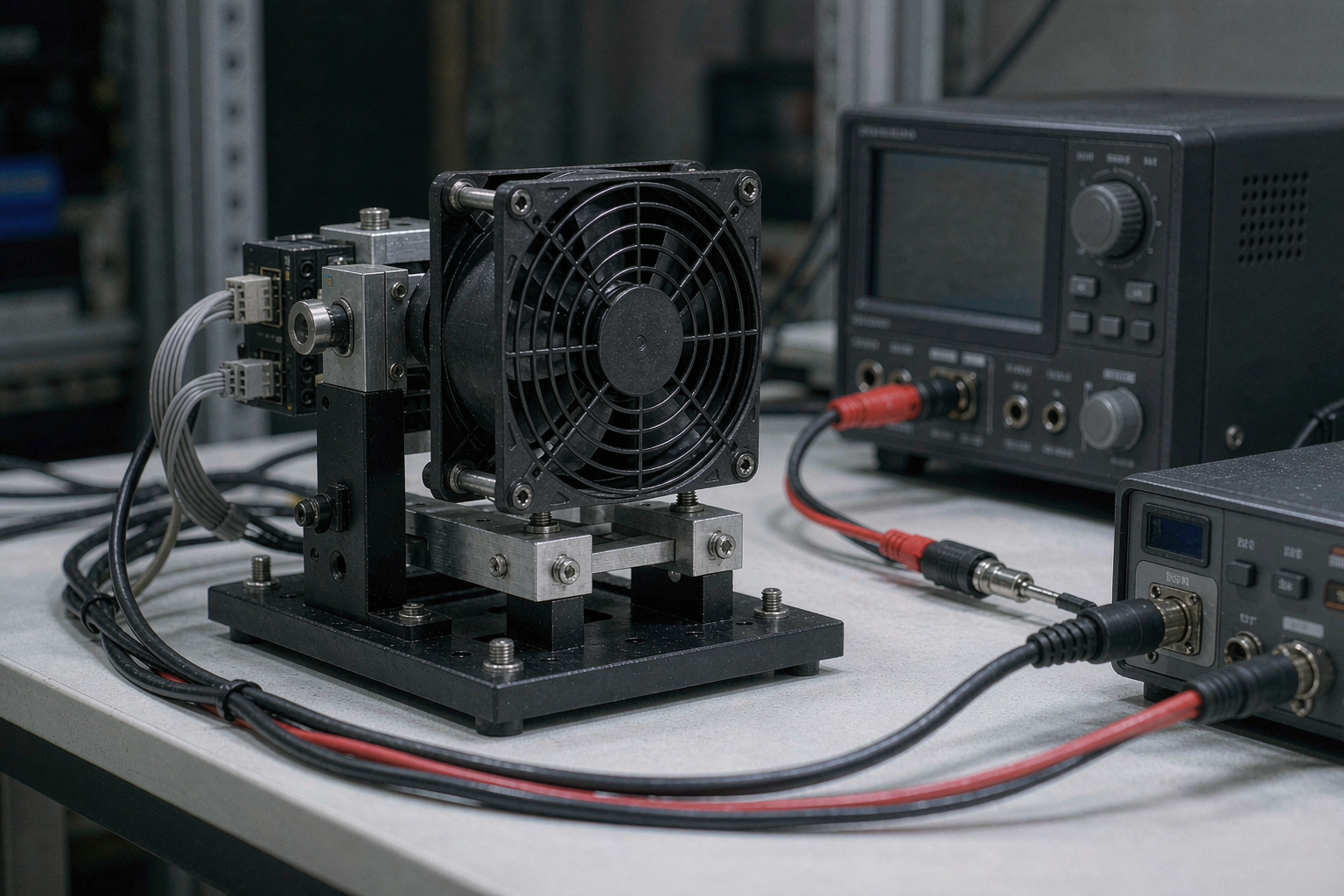
OEM validation of a 24V DC cooling fan on the test bench
Catalog specifications help engineers narrow the selection, but they do not replace equipment-level testing.
For OEM approval, a 24V cooling fan should be evaluated in the actual mechanical installation, with representative electrical supply and thermal conditions.
Testing should focus on whether the selected fan maintains the required cooling performance across the equipment's intended operating range.
| Validation item | What to confirm |
|---|---|
| Mechanical fit | Frame dimensions, mounting holes, depth, clearance and airflow direction |
| Electrical supply | Compatible operating-voltage range, current and startup behavior |
| P-Q performance | Required airflow at the expected system resistance |
| Thermal performance | Acceptable temperatures at critical components under representative loads |
| Acoustic behavior | Noise within the equipment's intended operating environment |
| Control compatibility | Required PWM, FG, RD or other options on the approved configuration |
| Production specification | Exact model number, bearing option, connector, wiring and acceptance criteria |
A fan that operates successfully on an open test bench may produce different cooling results after installation behind a filter or inside a crowded enclosure.
Testing should therefore include the final airflow path whenever possible.
Where multiple fans are under consideration, engineers can compare their installed temperatures, current consumption, noise, and control behavior under the same equipment conditions.
The outcome should be documented against predefined acceptance criteria.
FAQs About 40mm, 50mm and 80mm 24V DC Fans
Can a 40mm 24V fan provide more static pressure than an 80mm fan?
Yes. Static pressure depends on fan design, speed, and other characteristics, not just frame size. For example, YCCFAN's 40mm YDH4028B24G has a published maximum static pressure of 26.22 mmH2O, compared with 8.95 mmH2O for the 80mm YDD8020X24F. Their actual airflow at a particular resistance must still be compared using P-Q curves.
Is a 50mm DC fan a suitable alternative to a 40mm fan?
It can be, provided the equipment supports the larger mounting dimensions and installation depth. A 50mm model such as DC5020 offers a different airflow-pressure combination from thinner or high-pressure 40mm models. Engineers should compare the exact configurations rather than assume that 50mm is always better.
Which 80mm 24V fan is better for a shallow enclosure?
Where the equipment can accommodate an 80mm opening but has limited depth, the 15mm-deep DC8015 may be more suitable than the 20mm-deep DC8020. However, the DC8015 must still provide enough airflow at the equipment's system resistance and meet its thermal requirements.
Does a higher-RPM 24V fan always provide better cooling?
No. Higher RPM may increase airflow and pressure within a particular fan design, but installed cooling performance depends on the P-Q curve, system resistance, airflow path, and heat distribution. Comparing RPM alone cannot determine which fan will cool a particular device more effectively.
Conclusion
Choosing between 40mm, 50mm, and 80mm 24V DC cooling fans requires balancing mechanical dimensions, airflow, static pressure, electrical demand, and noise.
The published YCCFAN models show that a larger fan does not always provide greater maximum static pressure, while two fans with the same frame width can have substantially different performance because of their depth and design.
For compact electronics, high-resistance cooling paths, or wider ventilation openings, selecting the appropriate configuration begins with the equipment's actual requirements.
YCCFAN provides 24V DC fan options across these frame sizes, including thin-frame and high-pressure configurations.
For OEM projects, share your mounting dimensions, available depth, required airflow, system resistance, noise limits, and control requirements to review suitable fan models and arrange sample validation.