





How to Choose the Right 80mm Fan: Size, Airflow & Pressure
Choosing the right 80mm fan starts with more than confirming an 80mm frame. You also need to check the available installation depth, mounting dimensions, supply voltage, required airflow, static pressure, noise target and control functions.
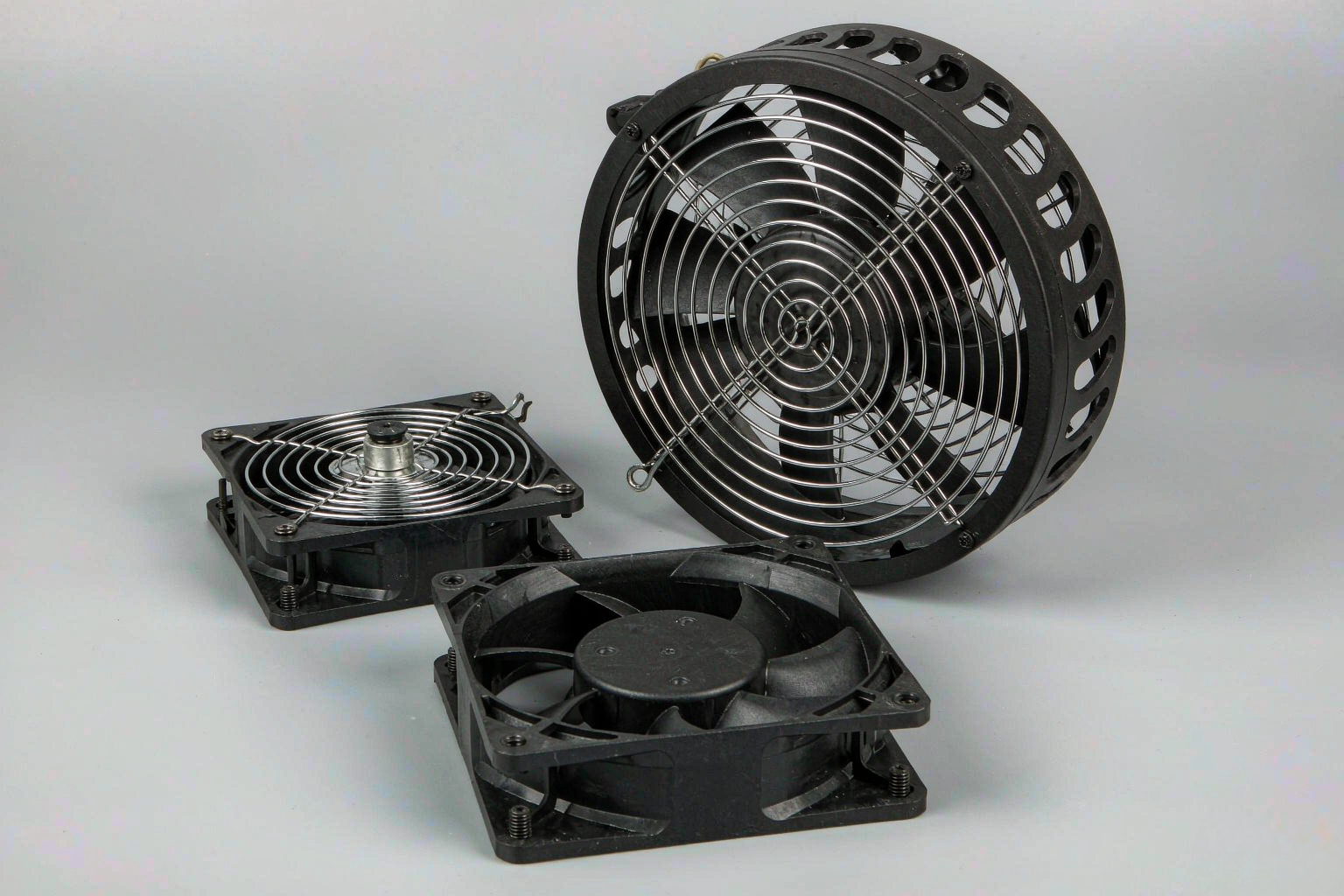
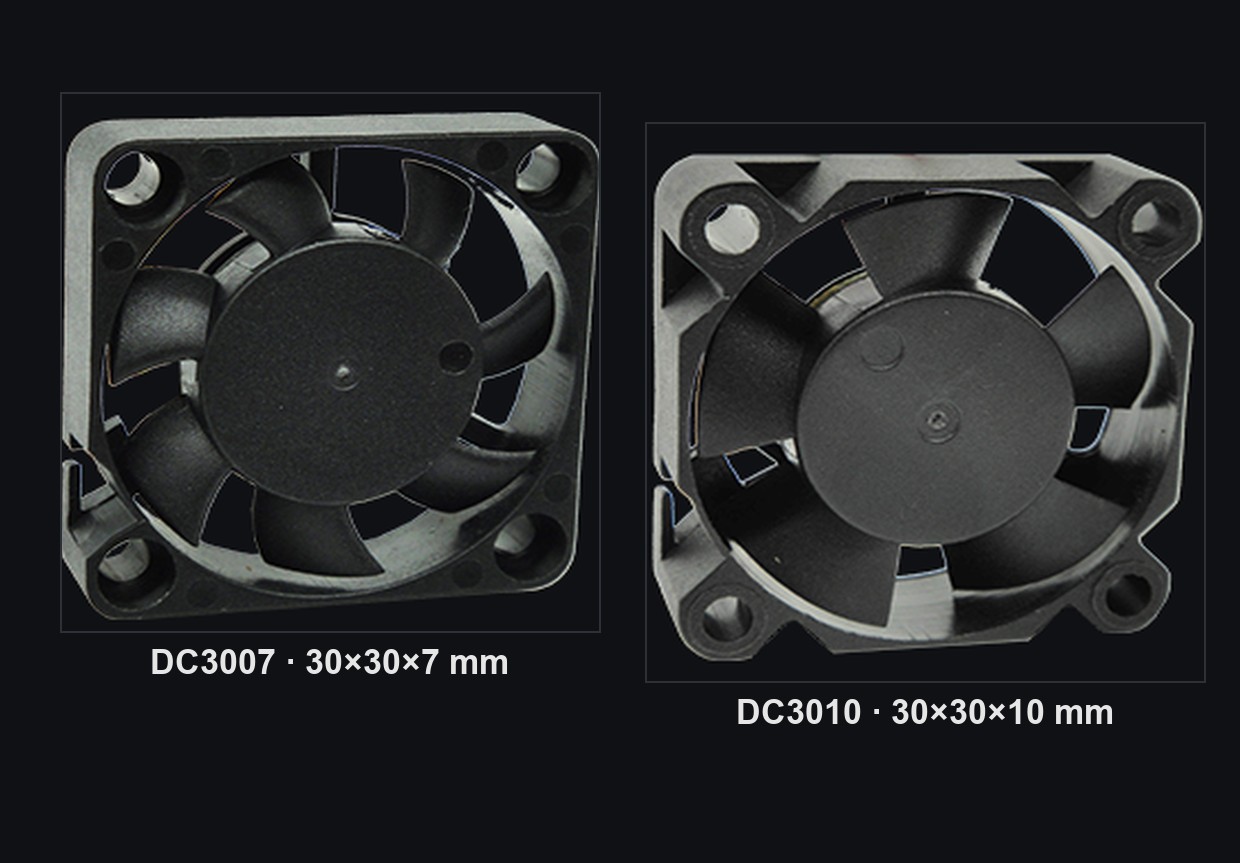
An 80mm fan normally refers to an approximately 80×80mm frame, but the thickness is not fixed. Different designs may use 15mm, 20mm, 25mm or deeper frames depending on the available installation space and cooling requirement.
For example, the YCCFAN DC8020 is an 80×80×20mm DC fan available in 12V and 24V versions. Its four speed levels range from 2,500 to 5,500 RPM, with listed airflow from 24.52 to 53.94 CFM and maximum static pressure from 2.20 to 8.95 mmH₂O.
The correct fan should therefore be selected from the required operating point and installation conditions rather than maximum airflow alone.
Where Are 80mm Fans Commonly Used?
An 80mm frame is commonly used where equipment requires meaningful airflow but has limited mounting space. Typical applications include electronic enclosures, power equipment, communication systems, industrial control equipment and compact computing hardware.

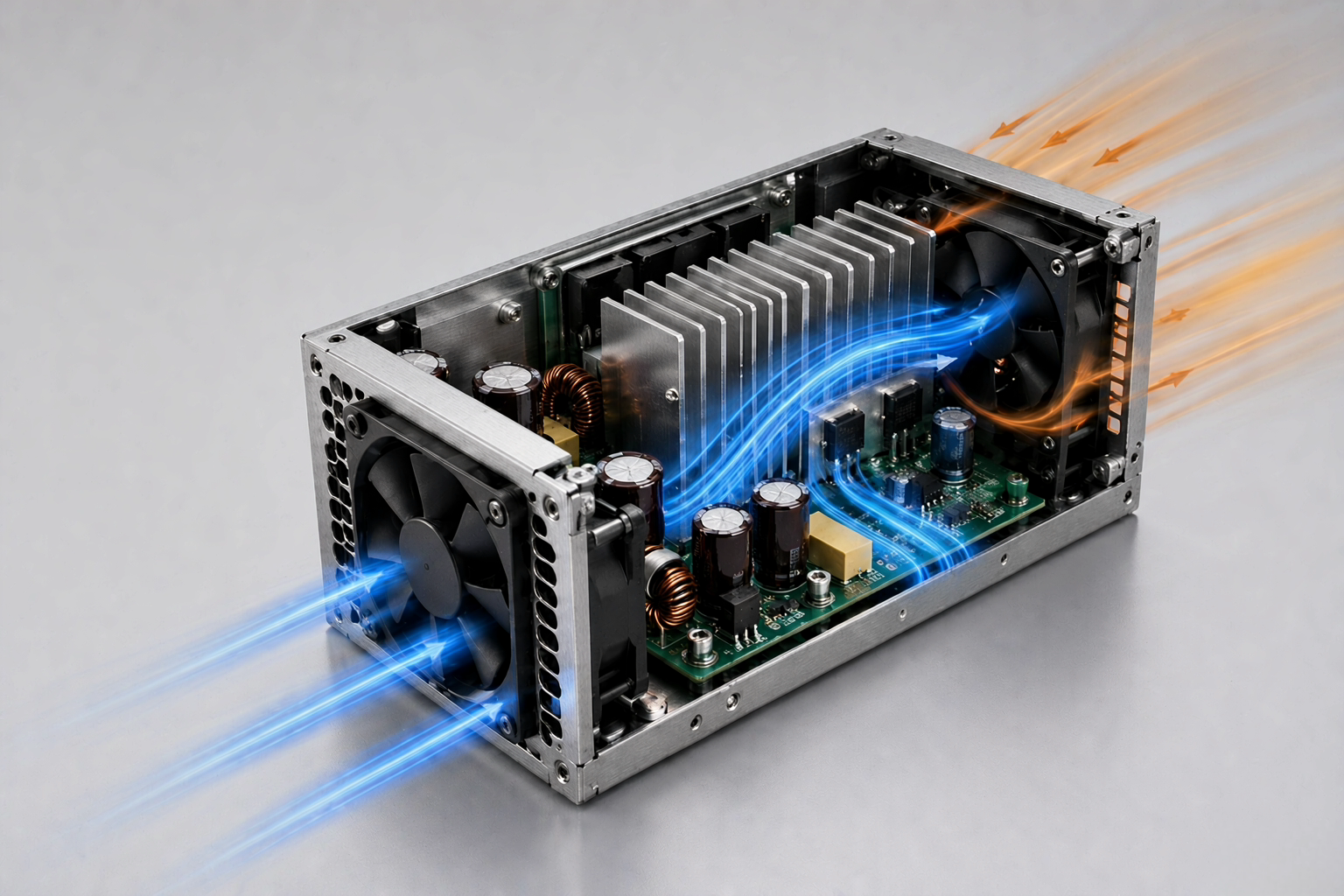
An 80mm DC fan installed in an electronics enclosure, moving air across the internal components and out of the outlet vents.
The application name alone, however, does not determine the correct fan. Two devices with the same 80mm mounting position can have very different airflow resistance, available depth, supply voltage and acoustic requirements. These factors should be checked before comparing individual fan models.
What Are the Dimensions of an 80mm Fan?
An 80mm fan size normally describes the width and height of the square fan frame: approximately 80×80mm. It does not mean every 80mm fan has the same thickness.
An 80x80mm fan may use a 15mm, 20mm, 25mm or deeper frame, so available installation depth should always be checked separately.
Use the following YCCFAN examples to show the difference:
| YCCFAN Model | Frame Size | Main Mechanical Difference |
|---|---|---|
| DC8015 | 80×80×15mm | 15mm nominal depth |
| DC8020 | 80×80×20mm | 20mm nominal depth |
| DC8025G | 80×80×25mm | 25mm nominal depth |
| DC8038 | 80×80×38mm | 38mm nominal depth |
Do not turn this table into four product advertisements. Its purpose is only to explain that “80mm” does not define the fan depth.
Mounting-hole spacing must also be checked from the drawing of the exact model. For the DC8020 80×80×20mm DC Fan, the current drawing specifies 71.5±0.3mm mounting-hole spacing. The complete 80×80×20mm dimensions, mounting clearance and wiring position should therefore be confirmed before replacing or designing in the fan.

YCCFAN DC8020 80×80×20mm dimension drawing: 80.0±0.50mm frame, 71.5±0.30mm mounting-hole spacing, 20.0±0.50mm depth and eight Ø4.3±0.3mm mounting holes.
A nominal 80mm frame alone is not enough to guarantee mechanical compatibility.
If your equipment can support more than one frame size, browse the YCCFAN DC fan range to compare 80mm models and the frame depths available in each series.
Choose the Voltage Before Comparing Fan Performance
The fan voltage should match the power supply available in the equipment. A higher supply voltage should not automatically be interpreted as higher cooling performance; voltage compatibility and fan performance are separate selection factors.
The YCCFAN DC8020 range is available in both 12 VDC and 24 VDC versions, with corresponding models at 2,500, 3,500, 4,500 and 5,500 RPM.
At each matching speed level, the current DC8020 specifications list the same airflow, static pressure and noise values for the 12V and 24V groups, while rated current differs.
For example, the 5,500 RPM 12V model is listed at 0.36 A, while the corresponding 24V model is listed at 0.19 A. Both list 53.94 CFM airflow, 8.95 mmH₂O maximum static pressure and 46.61 dBA noise.
The selection sequence should therefore be: confirm the equipment supply voltage first, then compare speed, airflow, static pressure, current and noise within the appropriate voltage group.
Airflow vs. Static Pressure: Choose the Operating Point, Not Just CFM
Airflow and static pressure describe different parts of fan performance.
Airflow, normally expressed in CFM, indicates how much air a fan can move when airflow resistance is low. Static pressure indicates the fan’s ability to maintain airflow when resistance is introduced by components such as filters, heatsinks, dense internal structures, restrictive grills or narrow vents.
For this reason, the fan with the highest maximum CFM is not automatically the best choice.
A fan performance curve shows how available airflow changes as system resistance increases. The actual operating point is determined by the relationship between the fan curve and the resistance of the assembled airflow path.
Use the YCCFAN DC8020 as a real example:
| Speed | Airflow | Max. Static Pressure | Noise |
|---|---|---|---|
| 2,500 RPM | 24.52 CFM | 2.20 mmH₂O | 25.34 dBA |
| 3,500 RPM | 34.33 CFM | 4.06 mmH₂O | 33.92 dBA |
| 4,500 RPM | 44.14 CFM | 6.47 mmH₂O | 40.11 dBA |
| 5,500 RPM | 53.94 CFM | 8.95 mmH₂O | 46.61 dBA |
These figures show the available performance levels within the same 80×80×20mm frame. However, maximum airflow and maximum static pressure occur at different points on the P-Q curve; they should not be treated as one simultaneous operating point.
The DC8020 product page provides separate curves for 2,500, 3,500, 4,500 and 5,500 RPM. The relevant curve should be compared with the expected resistance of the assembled equipment before a final model is selected.

YCCFAN DC8020 P-Q curves: air flow (CFM) against air pressure (mmaq) for the 2,500, 3,500, 4,500 and 5,500 RPM versions of the 80×80×20mm fan.
How Noise Changes with 80mm Fan Speed
Noise should be evaluated together with the required cooling performance rather than against a universal “quiet fan” number.
Within the YCCFAN DC8020 range, the listed noise level rises from 25.34 dBA at 2,500 RPM to 46.61 dBA at 5,500 RPM as the available airflow and static-pressure capability increase.
This shows the practical trade-off within one fan family. A higher-speed configuration can provide more cooling capability, but it also has a higher listed acoustic output.
For equipment design, evaluate the lowest speed that can still deliver sufficient airflow at the expected system resistance. If noise data from different products or suppliers are compared, also confirm that their measurement conditions are comparable.
Do not state that DC8020 is quieter than competing products unless equivalent test evidence exists.
How Bearing Type Affects 80mm Fan Selection
Bearing selection can affect operating behavior and long-term reliability, but lifetime figures should only be compared when the corresponding test conditions are known.
The current YCCFAN DC8020 configuration provides ball bearing and CycleSeal bearing options. The appropriate bearing choice should be confirmed according to the operating environment, duty cycle and project requirements rather than selected from a generic lifetime estimate.
If service life is a critical purchasing requirement, request the lifetime specification and corresponding test conditions for the exact fan model being evaluated.
This avoids comparing bearing-life figures measured under different temperatures, speeds or operating conditions.
Control and Monitoring Functions to Confirm Before Ordering
Fan selection may also depend on how the equipment controls or monitors the fan after installation.
For the YCCFAN DC8020 series, the current product configuration lists FG, RD, PWM, auto restart and polarity protection as available function options according to project requirements.
When requesting a model, specify whether the equipment requires speed control, fan-status feedback or other control functions rather than assuming that every fan configuration uses the same wiring and signal options.
The required function combination should be confirmed for the exact model before ordering. The available options are listed on the DC8020 80mm DC fan specification page.
A Practical YCCFAN DC8020 Selection Example
The YCCFAN DC8020 provides a practical example of how an 80mm fan can be selected from actual equipment requirements rather than frame size alone.
Suppose an enclosure provides an 80×80mm mounting position, approximately 20mm of available fan depth and a 24VDC power supply. The first step is to confirm the mechanical drawing, including the 71.5±0.3mm mounting-hole spacing and sufficient clearance around the inlet, outlet and wiring.
The selection can then be narrowed to the 24V DC8020 models. If system resistance is relatively low and the application has a lower acoustic target, the 2,500 or 3,500 RPM curves can be evaluated first.
If the airflow path includes restrictive vents, filters, dense internal components or other sources of resistance, the 4,500 and 5,500 RPM curves provide higher available static-pressure capability and should be compared with the expected system resistance.
The highest-speed model should not be selected automatically. The final choice should be based on the required operating point, acceptable noise level, current draw and control-function requirements.
For full specifications, see the DC8020 product page.
5 Steps for Selecting an 80mm Fan
- Confirm the installation size. Check the 80×80mm frame, available fan depth, mounting-hole spacing and clearance around the inlet and outlet.
- Match the supply voltage. Select the voltage group that matches the equipment power supply before comparing current and performance.
- Define the required operating point. Estimate the cooling requirement and the resistance created by filters, vents, heatsinks and internal components.
- Compare the fan curve, noise and control functions. Select a speed that provides sufficient airflow at the required pressure while meeting the project’s acoustic and control requirements.
- Validate the fan in the assembled equipment. Prototype testing should confirm temperature, airflow, noise and fan-control behavior under representative operating conditions.
What Information Should You Send for an 80mm Fan Recommendation?
For an OEM or equipment project, providing the operating requirements makes fan selection more accurate than requesting an “80mm fan” alone.
When contacting YCCFAN, provide the available frame size and depth, supply voltage, target airflow or cooling requirement, expected airflow restrictions, acceptable noise level, operating environment and any required PWM, FG, RD or connector configuration.
For the DC8020 series, ball bearing and CycleSeal bearing choices are available, while FG, RD, PWM, auto restart and polarity protection can be specified according to project requirements.
Providing this information allows the selection to be narrowed to a specific configuration before samples or production quantities are discussed.
YCCFAN Fan Development and Testing Capabilities
YCCFAN develops and manufactures cooling fans in Shenzhen, China. Its product development and production system includes a Reliability Laboratory, Noise Testing Room and Air Flow and Pressure Testing Chamber, together with mold manufacturing, plastic injection, automated production and automated inspection capabilities.
The company operates under ISO 9001, ISO 14001 and IATF 16949 management systems and supports OEM/ODM cooling-fan projects.
For fan selection, these capabilities are relevant because airflow, pressure, noise, reliability and mechanical configuration need to be evaluated against the requirements of the final equipment.
FAQ
What are the dimensions of an 80mm fan?
An 80mm fan normally has an approximately 80×80mm frame, but the depth can vary by model. For example, YCCFAN offers 80mm-frame DC fans with 15mm, 20mm, 25mm and 38mm nominal depths. The frame size, fan depth and mechanical drawing should all be checked before installation.
Are all 80mm fans 25mm thick?
No. The “80mm” designation normally describes the width and height of the frame rather than its depth. YCCFAN DC8015 measures 80×80×15mm, DC8020 measures 80×80×20mm, DC8025G uses an 80×80×25mm frame, and DC8038 uses an 80×80×38mm frame.
What is the mounting-hole spacing of an 80mm fan?
Mounting-hole spacing should be confirmed from the drawing of the exact model rather than assumed from the nominal frame size. For example, the current YCCFAN DC8020 drawing specifies 71.5±0.3mm mounting-hole spacing within its 80×80×20mm frame.
How much CFM does an 80mm fan provide?
There is no single airflow value for every 80mm fan. Airflow depends on frame depth, speed, motor and blade design. The YCCFAN DC8020 range, for example, lists 24.52 to 53.94 CFM across four speed levels from 2,500 to 5,500 RPM.
Should I choose an 80mm fan by airflow or static pressure?
Both should be considered. Maximum airflow is most useful when system resistance is low, while static-pressure capability becomes increasingly important when air must pass through filters, heatsinks, restrictive vents or dense internal components. The fan’s P-Q curve should therefore be evaluated against the expected system operating point.
How do I choose between a 12V and 24V 80mm fan?
Match the fan voltage to the equipment power supply first. The YCCFAN DC8020 range provides 12V and 24V versions at the same four speed levels. After selecting the correct voltage group, compare airflow, static pressure, current, noise and required control functions for the intended operating point.
Final Takeaway
Choosing an 80mm fan requires more than matching an 80mm frame. Confirm the available depth and mounting dimensions first, then match the supply voltage and evaluate airflow, static pressure, noise and control requirements at the expected operating point.
The YCCFAN DC8020 shows how several performance levels can be offered within the same 80×80×20mm installation size. Its four speed options and corresponding P-Q curves allow equipment designers to compare performance without relying on maximum CFM alone.
For a new equipment design or replacement project, verify the final fan in the assembled system before moving to volume production.
Need Help Selecting an 80mm Fan?
Send your installation size, voltage, airflow or pressure requirement and control-function needs. YCCFAN can help identify a suitable configuration and provide product data for project evaluation.
Request 80mm Fan Selection SupportView DC8020 Specifications
Compare 80mm DC cooling fans by airflow, static pressure and thickness before fixing the mounting layout.