





Axial Fan Supplier Guide: Key Specifications Buyers Should Compare
In this guide, we will walk through the key axial fan specifications you should compare before sourcing. We will also show how you can use these parameters to evaluate a technical supplier like YCCFAN for OEM/ODM cooling fan projects.
Table of Contents
1.Why Axial Fan Specifications Matter for Buyers
2.Compare Fan Size, Voltage, and Speed First
3.Airflow and Static Pressure: The Core Performance Parameters
4.Noise Level, Bearing Type, and Life Expectancy
5.IP Rating, Wire Connector, and Custom Requirements
6.Certifications and Quality Standards for Axial Fan Sourcing
7.Axial Fan Specification Comparison Checklist
8.Using This Checklist to Evaluate an Axial Fan Supplier Like YCCFAN
Why Axial Fan Specifications Matter for Buyers
When we help buyers compare axial fans, we usually do not start with price. Price matters, but it should come after the technical requirements are clear. A fan that looks similar in size may perform very differently in airflow, noise, pressure, life, and reliability.
As a buyer, you need to know where the fan will be used, how much space is available, how much heat needs to be removed, and whether the product will work in a quiet, dusty, humid, high-temperature, or long-running environment.
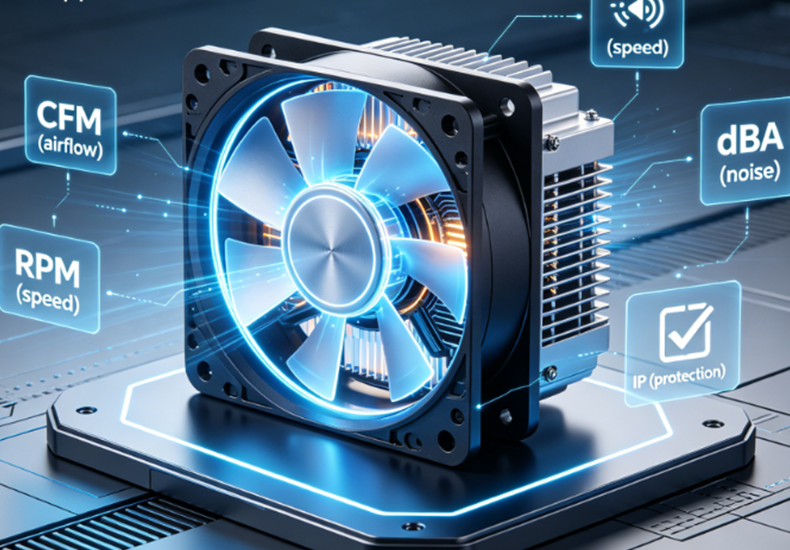
A professional axial fan supplier should help you compare specifications based on real working conditions, not just send a datasheet. For example, a higher-speed fan may increase airflow, but it may also create more noise. A smaller fan may save space, but it may not provide enough cooling capacity. A low-cost bearing may reduce the unit price, but it may not be suitable for continuous operation.
Compare Axial Fan Size, Voltage, and Speed First
Fan size, voltage, and speed are the first parameters you should check because they decide whether the fan can be installed, powered, and operated correctly.
1.Axial Fan Size and Installation Space
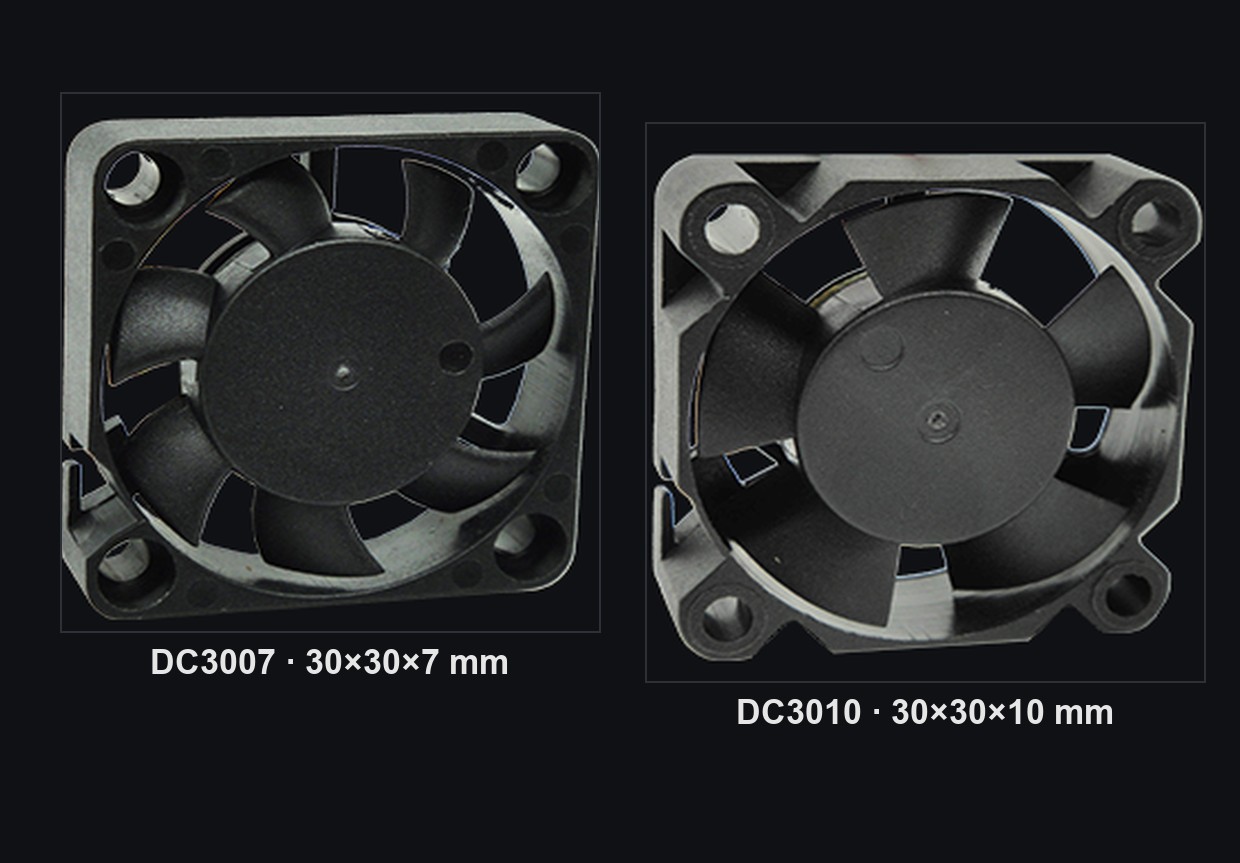
Fan size includes frame size, thickness, mounting holes, and available internal space. Even a small difference in thickness or screw hole position may affect assembly.
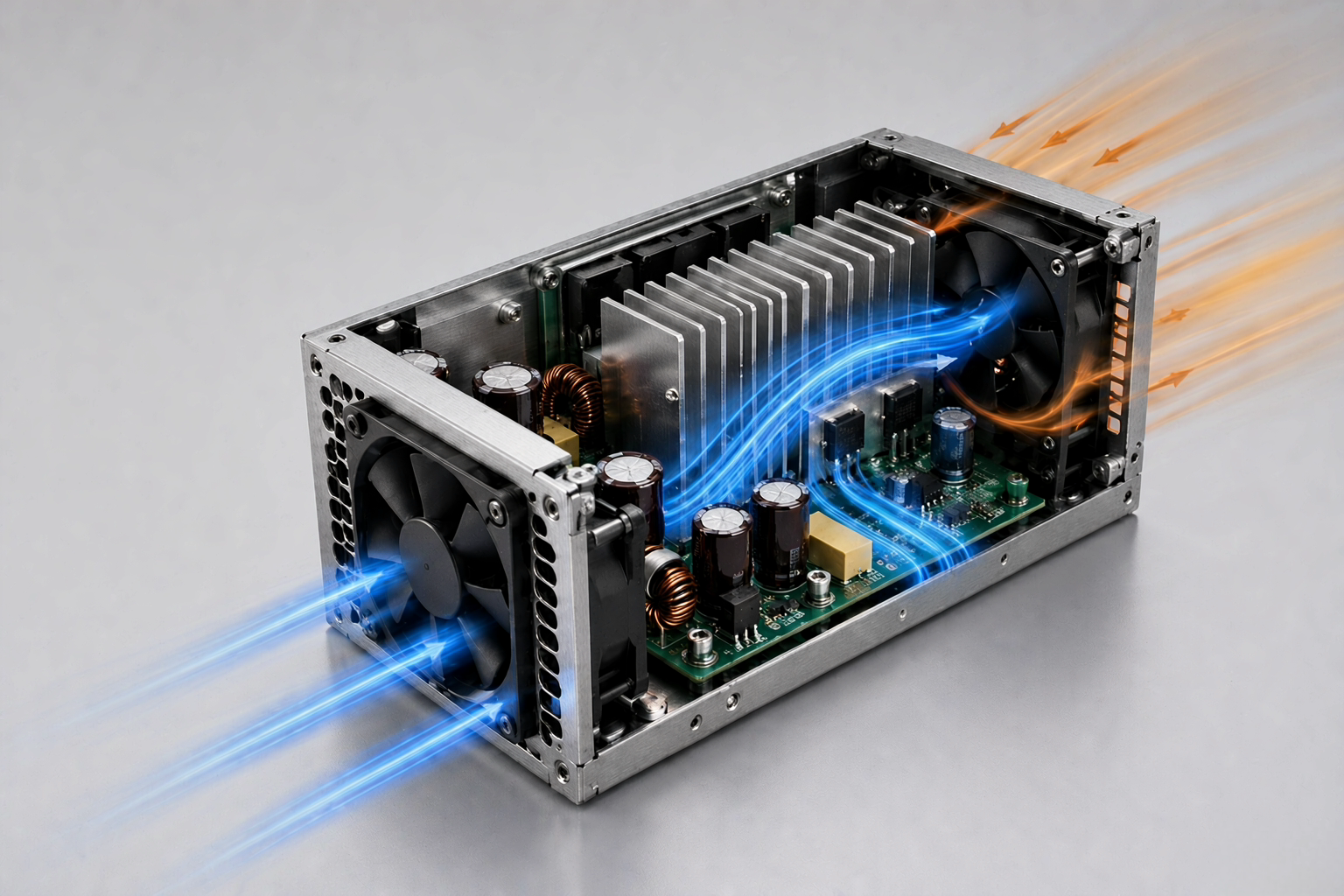
When you compare fan size, do not only check the outer dimensions. You should also consider airflow direction, nearby components, installation angle, and whether the fan has enough space to intake and exhaust air smoothly.
For compact devices, smaller fans may be necessary. For industrial or high-power equipment, larger fans may provide better airflow with lower noise. The right size depends on both structure and cooling demand.
Comparing DC axial fan specifications side by side, including size, voltage, speed, airflow and static pressure, makes supplier quotes much easier to evaluate.
2.Fan Voltage Options for DC and AC Axial Fans
Fan voltage must match your equipment power system. Common DC axial fan voltages may include 5V, 12V, 24V, and 48V, while some applications may use AC fans.
When you compare voltage, you should also check current, power consumption, starting voltage, and operating voltage range. A fan may be rated at a certain voltage, but your actual system may require wider tolerance or more stable startup performance.
3.Axial Fan Speed and Performance Balance
Fan speed is usually measured in RPM. Higher speed often brings stronger airflow, but it may also increase noise, vibration, power consumption, and bearing load.
That is why we should not choose a fan only because it has the highest RPM. A better choice is the fan that gives you enough cooling performance while keeping noise, power, and life within acceptable limits.
Airflow and Static Pressure: The Core Performance Parameters
Among all axial fan specifications, airflow and static pressure are the two parameters buyers should compare carefully.
1.What airflow tells you
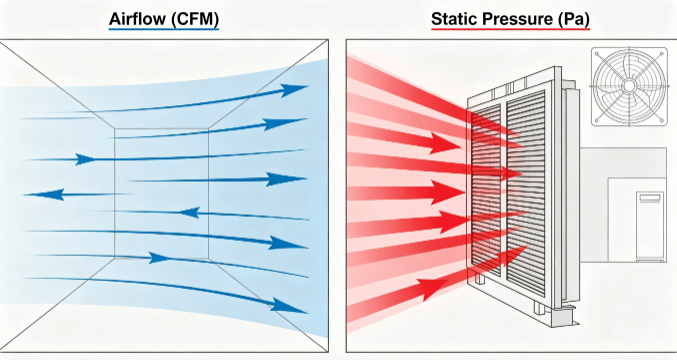
Airflow shows how much air the fan can move in a certain time. It is usually measured in CFM or m³/h. If your application has an open airflow path, airflow may be the main performance target.
For example, if the fan is used for general cabinet ventilation, you may need to focus on how much air it can move through the enclosure. However, airflow data should always be checked together with the test condition.
2.Why static pressure matters
Static pressure shows how well the fan can push air through resistance. This is important when air needs to pass through heat sinks, filters, ducts, dense components, or narrow spaces.
A fan with high airflow but low static pressure may not perform well inside a restricted structure. If your equipment has limited airflow paths, you should compare static pressure carefully instead of only looking at CFM.
3.Noise Level, Bearing Type, and Life Expectancy
After airflow and pressure, you should compare noise, bearing type, and expected life. These parameters affect user experience and long-term reliability.
4.Fan noise level
Fan noise level is usually measured in dBA. Noise is especially important for home appliances, medical devices, office equipment, communication terminals, and indoor electronics.
However, noise should not be judged by one number only. You should check the test distance, test environment, fan speed, and whether the noise value is measured under rated operating conditions.
If your product requires quiet operation, we may need to balance fan speed, blade design, bearing type, and airflow target together.
5.Fan bearing type
Fan bearing type affects noise, cost, service life, and operating stability. Common options include sleeve bearing, ball bearing, and other enhanced bearing designs depending on the project.
Sleeve bearings may be suitable for general or cost-sensitive applications. Ball bearings are often used for longer operation or more demanding environments. For projects that require low noise or longer life, bearing selection should be discussed early.
6.Fan life expectancy
Fan life expectancy depends on temperature, speed, bearing system, operating hours, and working environment. When you compare life data, you should check the rated condition behind the number.
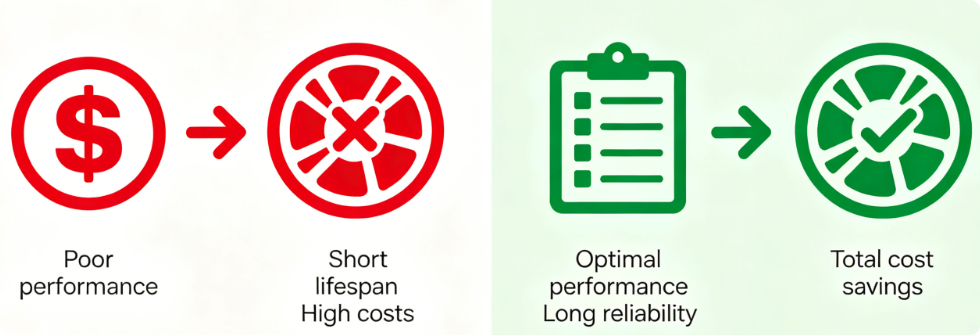
For example, a fan used in communication equipment or energy storage systems may need long-term continuous operation. In that case, reliability testing and bearing selection become more important than initial cost.
IP Rating, Wire Connector, and Custom Axial Fan Requirements
For OEM/ODM projects, standard specifications may not be enough. You may need to confirm protection level, wiring, connector type, signal function, labels, or structural details before sampling.
1.IP Rated Axial Fan for Harsh Environments
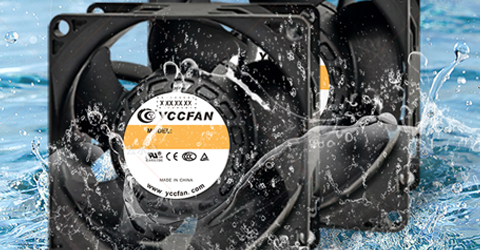
An IP rated axial fan may be required for dusty, humid, outdoor, or industrial environments. The IP rating should match the actual working condition, not simply be selected as high as possible, because higher protection may also affect cost and structure.
2.Axial Fan Wire Connector and Signal Functions
Axial fan wire connector details can affect assembly efficiency and system compatibility. You should confirm cable length, wire gauge, terminal type, connector direction, and whether functions such as PWM, FG, or RD signals are needed.
3.Custom Axial Fan Requirements for OEM/ODM Projects
Common custom requirements may include special frame structure, custom wire and terminal, PWM speed control, FG/RD signal output, waterproof or dustproof design, custom labels, packaging, material, color, or mold development.
For this type of project, supplier capability matters. You are not only comparing fan models, but also checking whether the supplier can understand your application, adjust details, and support repeatable production. YCCFAN can be used as a practical reference when you need to discuss structure, cable, connector, airflow, noise, protection, and OEM/ODM requirements within one project workflow.
Certifications and Quality Standards for Axial Fan Sourcing
Certifications help reduce market access and compliance risks. Before sourcing, you should confirm whether the required standards match your target market, product application, and selected fan model.
1.Common Axial Fan Certifications
Common axial fan certification requirements may include UL, CUL, TUV, CE, SGS, CCC, and other market-related approvals. For quality management, buyers may also check ISO9001, ISO14001, or IATF16949 depending on the application.
2.What to Check Beyond Axial Fan Certificates
Certificates are useful, but you should also confirm model coverage, certificate validity, target market fit, available test reports, inspection process, and batch traceability.
A reliable supplier should help you connect certification, testing, and quality control with your actual project needs.
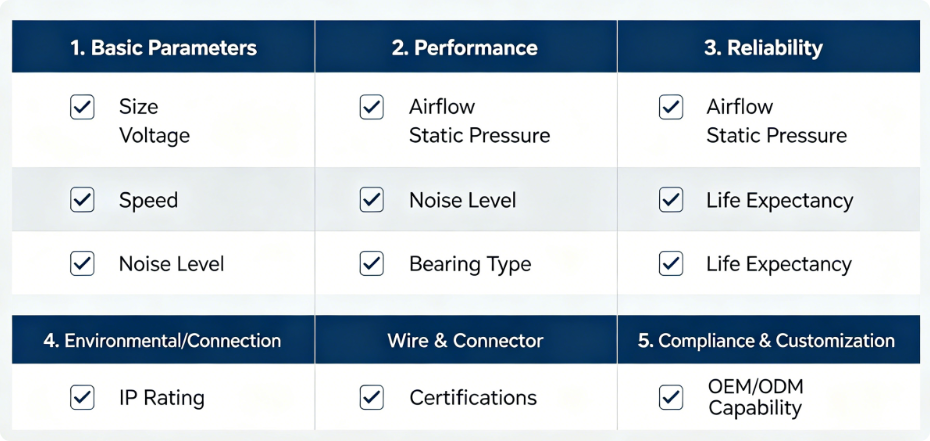
3.Axial Fan Specification Comparison Checklist
The table below can help you compare different axial fan models or suppliers more clearly.
Specification | What You Should Compare | Why It Matters |
Size | Frame size, thickness, mounting holes | Ensures installation fit |
Voltage | Rated voltage and operating range | Matches your power system |
Speed | RPM and speed tolerance | Affects airflow, noise, and life |
Airflow | CFM or m³/h | Shows air-moving capacity |
Static Pressure | Pa or mmH₂O | Important for restricted airflow paths |
Noise Level | dBA and test condition | Affects user experience |
Bearing Type | Sleeve, ball, or custom option | Influences life and stability |
Life Expectancy | Rated life under defined conditions | Reduces long-term failure risk |
IP Rating | Dust and water protection level | Needed for harsh environments |
Wire & Connector | Cable length, terminal, signal wires | Cable length, terminal, signal wires |
Certification | UL, CE, TUV, CCC, etc. | Supports market compliance |
Customization | Mold, structure, label, packaging | Supports OEM/ODM projects |
Using This Checklist to Evaluate an Axial Fan Supplier Like YCCFAN
Choosing an axial fan is not a single-parameter decision. You need to compare size, voltage, speed, airflow, static pressure, noise, bearing type, life expectancy, IP rating, connector design, and certification requirements based on your real application.
You can also use this checklist when evaluating YCCFAN as an axial fan supplier. Instead of only asking for a datasheet, you can discuss installation space, cooling targets, noise limits, connector requirements, certification needs, and long-term production expectations with our team.
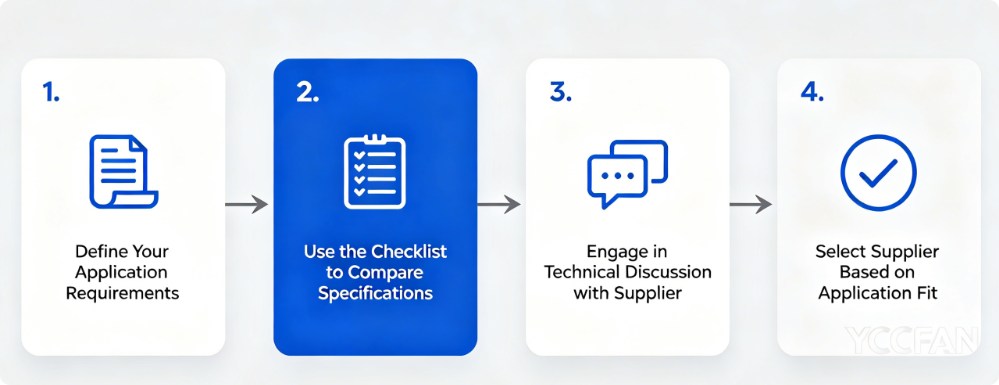
For OEM/ODM projects, this type of technical discussion is especially important. A suitable supplier should help you move from parameter comparison to actual application matching.
With experience in cooling fan production, testing, customization, and project support, YCCFAN can be included in your supplier evaluation process when you are looking for reliable axial cooling fan solutions.
Frequently Asked Questions
1.What specifications should buyers compare when choosing an axial fan?
Buyers should compare fan size, voltage, speed, airflow, static pressure, noise level, bearing type, life expectancy, IP rating, wire connector, signal functions, certifications, and customization requirements. These specifications help determine whether the fan can match the real application.
2.What is more important, airflow or static pressure?
It depends on the application. If the airflow path is open, airflow is usually more important. If air must pass through filters, heat sinks, ducts, or dense components, static pressure becomes more important. In many projects, buyers need to compare both.
3.When do I need an IP rated axial fan?
You may need an IP rated axial fan if the fan is used in dusty, humid, outdoor, or industrial environments. The IP rating should match the actual working condition instead of being selected as high as possible.
4.Can axial fans be customized for OEM/ODM projects?
Yes. Axial fans can often be customized in size, voltage, speed, wire length, connector type, signal function, IP rating, label, packaging, structure, or mold design. For OEM/ODM projects, these details should be confirmed before sampling.
5.What certifications should an axial fan supplier provide?
Common certifications may include UL, CUL, TUV, CE, SGS, CCC, and other market-related approvals. Buyers may also check ISO9001, ISO14001, or IATF16949 depending on the product application and target market.
6.Can YCCFAN support custom axial fan projects?
Yes. YCCFAN can support custom axial fan projects involving size selection, airflow requirements, noise control, wire connectors, protection design, and OEM/ODM customization. Buyers can discuss project requirements with YCCFAN before sampling.
7.Why should buyers consider YCCFAN as an axial fan supplier?
Buyers can consider YCCFAN because the company supports cooling fan R&D, testing, OEM/ODM customization, production, and quality control. This makes YCCFAN suitable for buyers who need more than standard axial fan models.
8.How can I evaluate YCCFAN for my axial fan project?
You can evaluate YCCFAN by sharing your application, installation space, voltage, airflow, static pressure, noise limit, connector requirements, IP rating needs, and certification requirements. Then you can compare the sample performance, test data, communication efficiency, and production support before making a decision.
Review YCCFAN’s DC axial fan catalog and send your specifications for samples and quotations.