



How to Choose a Truly Noiseless Cooling Fan
To choose a truly noiseless fan, you need to understand the causes of noise, key design factors, and the differences between fan types. Whether for cooling electronic devices, industrial systems, or use at home and in offices, knowing this information can help you select a high-performance, low-noise fan.
This article analyzes the sources of fan noise, explains key design indicators, and compares different fan types such as tower fans and air circulators, helping you fully understand how to choose an efficient and quiet cooling solution.
How Cooling Fan Noise Is Generated
From a fluid dynamics perspective, noise from a cooling fan does not come from a single factor. It results from airflow behavior, blade rotation, and the surrounding system structure working together. Engineering studies and flow field analysis show that fan noise mainly comes from three areas: outlet airflow noise, blade aerodynamic noise, and inlet airflow noise. Among these, the outlet region usually contributes the most to the overall sound pressure level (SPL). Blade rotation is the second major source, while the inlet area mainly affects sound quality rather than the total noise level.
1. Outlet Airflow Noise (Primary Source)
When a cooling fan runs, the blades accelerate the air and push it out of the outlet at high speed. This fast airflow then meets the surrounding still air. The large velocity difference creates a shear layer, which quickly develops into turbulence and small vortices.
These vortices form and shed continuously as the airflow moves forward. This process causes periodic pressure fluctuations in the air, and these pressure changes generate aerodynamic noise.
Noise can also increase when the airflow hits nearby structures. Common examples include fan grills, support frames, and heat sinks. In these situations, the airflow direction and speed change suddenly, which creates stronger pressure variations.
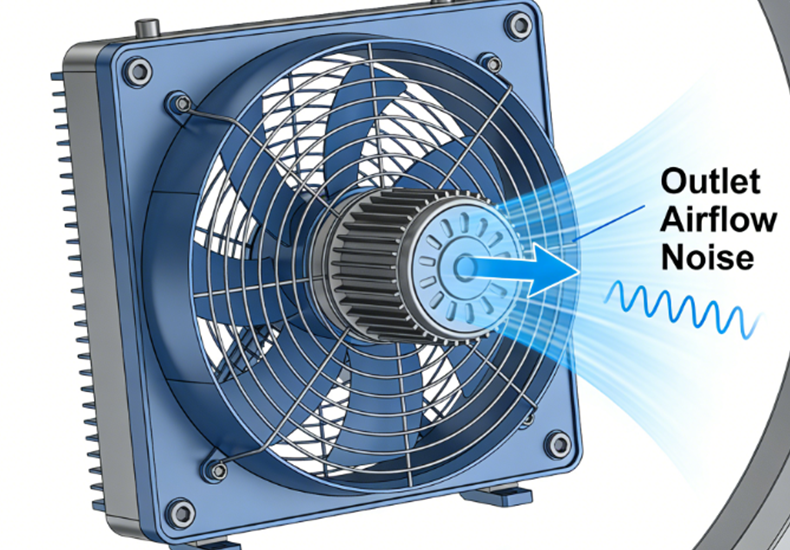
Flow field studies reveal an important pattern. Higher outlet velocity and uneven airflow distribution often lead to stronger vortices. Strong vortices increase the sound pressure level of a cooling fan. In contrast, a more uniform outlet airflow usually results in lower noise.
2. Aerodynamic Noise from Blade Rotation
The blades of a cooling fan interact with the air continuously during rotation. Each blade pushes air forward while cutting through the flow. This repeated interaction disturbs the surrounding air and produces aerodynamic noise.
This noise often appears as harmonic components in the frequency spectrum. The frequency is related to the blade number and the fan speed. Engineers usually refer to this as the blade passing frequency.
Blade design has a strong influence on this type of noise. Important factors include blade number, blade thickness, blade angle, and rotational speed. If the blade count is too low or the aerodynamic load is too high, airflow separation may occur on the blade surface. This separation can create strong vortices. High rotational speed can also increase airflow disturbance and raise noise levels.
For this reason, many cooling fan designs focus on optimized blade shapes, thinner blades, and controlled speeds. These approaches help reduce aerodynamic noise.
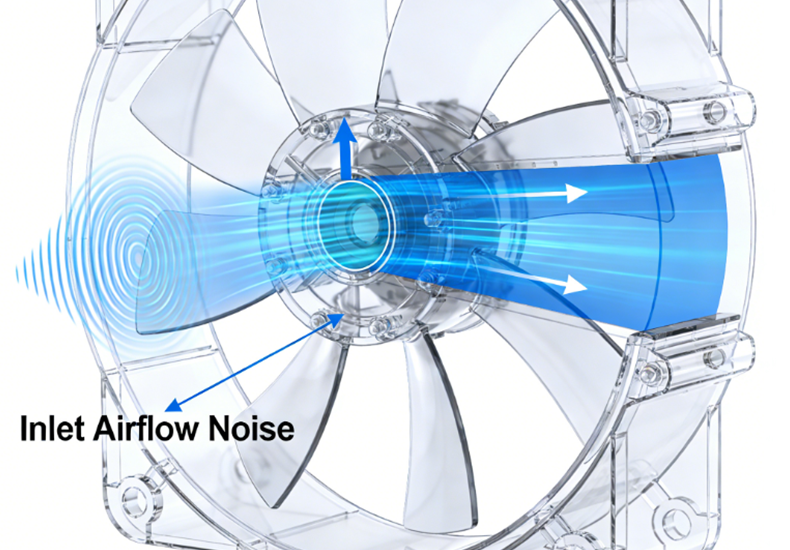
3. Inlet Airflow Noise (Mainly Affects Sound Quality)
Airflow speed at the inlet of a cooling fan is usually lower than at the outlet. Because of this, the inlet contributes less to the overall sound pressure level. However, it can still affect the sound quality of the fan.
The inlet airflow is mainly driven by static pressure. The incoming air does not follow a fixed direction. Instead, it naturally enters from the path with the least resistance.
This uneven intake flow can create unstable pressure distribution near the inlet. In some situations, it may produce whistling sounds or low-frequency fluctuations. These sounds can change how the cooling fan is perceived, even if the overall noise level remains relatively low.
Structures near the inlet can make this effect stronger. Examples include sharp edges, filters, or limited intake space. These features may create local vortices and unstable airflow.
Key Criteria for Choosing a Silent Cooling Fan
Choosing a truly silent cooling fan is not only about airflow or appearance. Several technical factors affect how quiet a fan operates. Motor technology, noise rating, and fan structure all play an important role. Understanding these factors helps you select a cooling fan that maintains effective cooling while keeping noise at a low level.
1. Choose a Brushless DC Motor (BLDC)
The brushless DC motor (BLDC) is a common technology in modern silent cooling fans. Compared with traditional motors, BLDC motors generate less vibration and deliver higher efficiency. They also run more smoothly.
BLDC motors do not use brushes. This reduces internal friction and helps lower mechanical noise during operation. Traditional AC motors usually create more vibration and sound while running. For this reason, many high-quality noiseless cooling fans adopt BLDC motors to achieve quieter performance.
2. Check the Noise Level (dB)
The noise rating (Decibel Rating, dB) is one of the most important specifications when selecting a noiseless cooling fan. A lower dB value means the fan produces less sound during operation. Different noise levels lead to different user experiences.
Noise Level | Experience |
25 dB | Nearly silent, close to natural background sound |
30 dB | Very quiet, suitable for quiet spaces |
35 dB | Light airflow sound |
45 dB | Similar to typical indoor noise |
You can also choose a noiseless cooling fan based on the application environment:
Bedroom: 25–35 dB
Office: 30–40 dB
Industrial equipment: 40–50 dB
Checking the decibel rating helps you estimate how quiet the cooling fan will be in daily use.

3. Consider the Low Noise Fan Type
Low noise fan design also influences noise performance. Different fan structures create airflow in different ways, which leads to different sound characteristics.
Tower fans use a vertical structure and produce more uniform airflow. They usually operate at a lower noise level. Many models also include sleep or quiet modes. This makes tower fans suitable for bedrooms and offices where a noiseless cooling fan is preferred.
Air circulators and bladeless fans are another option. These designs produce smoother and more stable airflow. They reduce airflow turbulence compared with traditional blade fans. As a result, the overall sound is softer and more comfortable. These fans are widely used in homes and office spaces.
Design Factors That Affect the Quiet Performance of a Noiseless Cooling Fan
Motor type and noise rating are important, but the structural design of a fan also affects how quietly it runs. Aerodynamic design and mechanical components both influence airflow behavior and vibration. These factors directly affect the overall noise of a noiseless cooling fan.
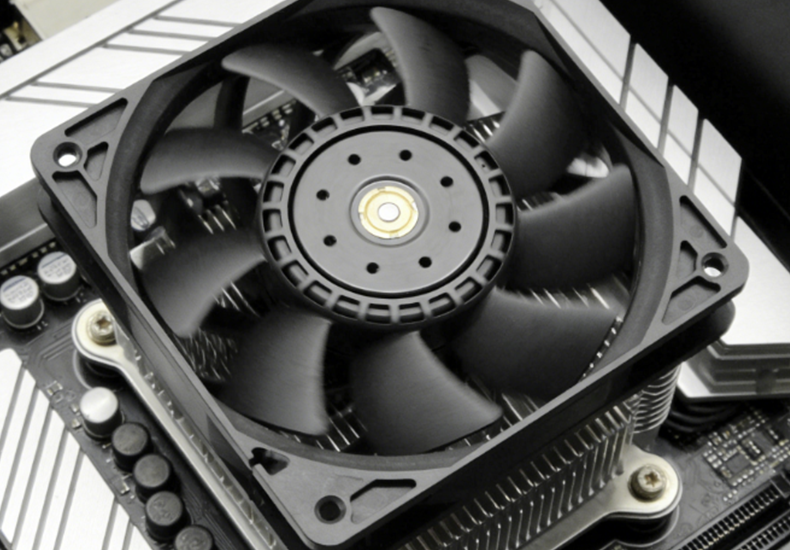
When evaluating a noiseless cooling fan, it is helpful to look at several key aspects. These include outlet airflow, blade structure, rotational speed, and bearing type.
1. Whether the Outlet Airflow Is Uniform
Research shows a clear relationship between airflow uniformity and fan noise. When the airflow at the outlet is evenly distributed, the flow becomes more stable. Turbulence and vortices are reduced. As a result, a low noise fan can operate more quietly.
If some areas of the outlet have much higher airflow speed, local high-speed airflow can appear. This uneven flow often creates strong vortices. It also causes continuous pressure fluctuations. These changes increase the overall sound pressure level (SPL) of the noiseless cooling fan.
An ideal outlet airflow usually has two features:
The airflow direction stays stable and close to vertical.
Air velocity across the outlet remains evenly distributed.
With a more stable airflow structure, air disturbance becomes smaller. The low noise fan can then run more smoothly and produce less noise.
2. Blade Design
Fan blades are the core component of aerodynamic performance. Their design directly affects airflow and noise levels. Key parameters include blade number, blade thickness, and blade tip design. These factors also play an important role in the performance of a noiseless cooling fan.
Blade number affects sweep area and aerodynamic load. More blades create a larger airflow area. Each blade carries a lower load. This helps reduce airflow disturbance and noise. Too many blades can increase air resistance and reduce efficiency. A well-designed noiseless cooling fan keeps a balance between airflow performance and noise.
Blade thickness also influences airflow. Thinner blades block less air and allow smoother airflow. This reduces turbulence during operation. Some modern high-end fans use advanced manufacturing to produce blades as thin as about 0.1 mm. Thin blades improve aerodynamic performance and support quieter operation.
Blade tip design is another important part of fan optimization. Some new fan designs use shorter blades or add small winglets at the blade tips. These features improve airflow structure and reduce vortices near the blade tips. Fewer vortices help a noiseless cooling fan operate more quietly and efficiently.
3. Quiet Fan Size and Speed
A common rule in fan design is:
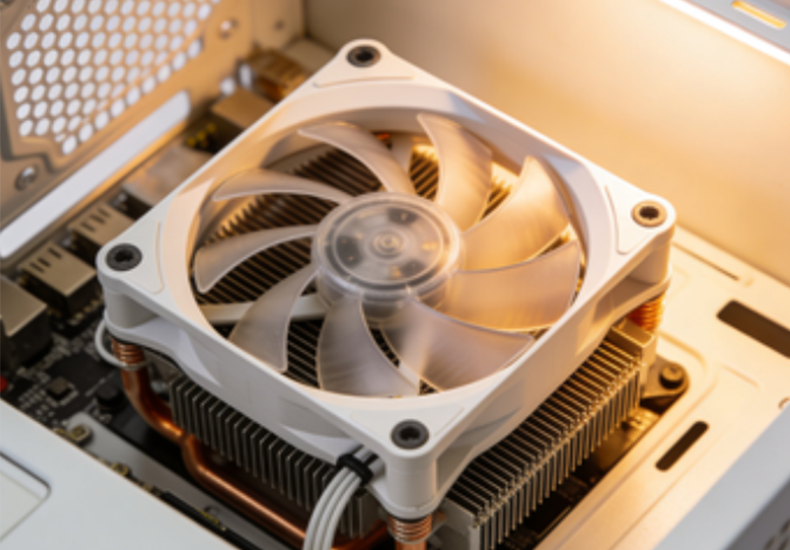
Large fan + low speed
is usually quieter than
Small fan + high speed.
Lower speed reduces airflow disturbance and mechanical vibration. It also produces less friction noise. Small quiet fans need higher speed to move the same amount of air, which increases both aerodynamic and mechanical noise.
For applications that require very quiet operation, a larger, low-speed design is often preferred. This helps a noiseless cooling fan run more smoothly and quietly.
4. Bearing Type
Bearings are a key mechanical part of a fan. They affect fan lifespan, vibration, and noise. Different bearing types have different noise levels and stability.
Common types of quiet fan bearings include:
Bearing Type | Noise Level |
Ball Bearing | Relatively noisy, but durable |
Sleeve Bearing | Quieter, stable operation |
Hydraulic Bearing | Very quiet, longer life |
Magnetic Levitation | Lowest vibration and noise |
In general, more advanced bearings produce less vibration and lower noise. Many high-end noiseless cooling fans now use hydraulic or magnetic levitation bearings to achieve quieter and more stable performance.
YCCFAN – A Trusted Brand for Noiseless Cooling Fans
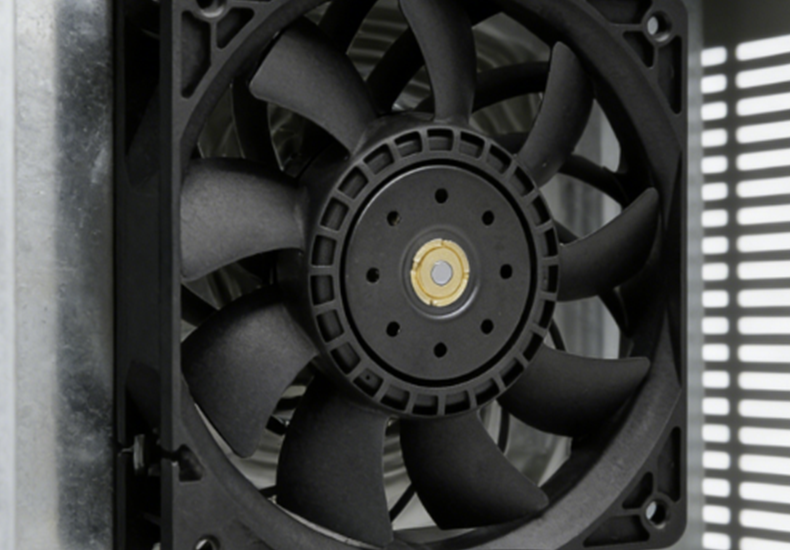
YCCFAN focuses on the research, development, and production of high-performance noiseless cooling fans. Its products are widely used in electronic devices, industrial systems, as well as office and home environments. Popular models such as the YCCFAN DC Brushless Fan, YCCFAN AC Cooling Fan, and YCCFAN Air Circulator are known for low noise, stable cooling performance, and high reliability, meeting the cooling needs of various applications.
As a professional fan manufacturer, YCCFAN has a complete R&D system and strict quality management processes. Its products are exported to multiple countries and regions worldwide and are highly trusted by customers. From brushless DC motor technology to advanced bearing designs, the brand demonstrates strong technical expertise and professional capability in the field of noiseless cooling and thermal management.
Read more:
https://www.yccfan.com/articledetail/precision-manufacturing-in-industrial-cooling-fans.html
https://www.yccfan.com/articledetail/noise-control-in-industrial-cooling-fans.html
Conclusion
Choosing a noiseless cooling fan not only controls noise but also affects device stability and user experience. With years of R&D experience and strict quality management, YCCFAN provides high-performance, low-noise fan solutions for a wide range of applications, earning the trust of customers worldwide.
Contact us today to explore more noiseless cooling fan models and keep your devices and spaces both efficiently cooled and quietly comfortable.