

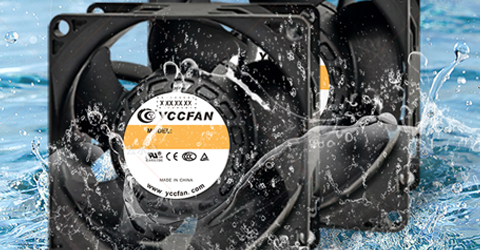




How to Select a DC Fan for an Inverter Without Oversizing It
Choosing an inverter fan is not simply a matter of selecting the highest-CFM model that fits the available space. A fan that is too small may leave power electronics operating at excessive temperatures, while an oversized fan can add unnecessary noise, power consumption and cost without delivering a proportional improvement in cooling.
A better approach is to match the fan to the inverter's actual thermal load, airflow resistance, installation space and control requirements. The right fan is the one that can provide enough airflow under real operating conditions, with a reasonable engineering margin but without unnecessary excess capacity.
Key Takeaways
- Select an inverter fan according to actual cooling demand and airflow resistance rather than maximum free-air CFM alone.
- Check the fan's P-Q curve to make sure it can still provide enough airflow after filters, grilles and heatsinks add resistance.
- Confirm voltage, dimensions, control signals, noise and operating environment before approving the final fan.
What Does an Inverter Cooling Fan Actually Need to Do?
An inverter cooling fan has one main job: move enough air through the thermally critical areas of the inverter to remove unwanted heat.
The required airflow depends on much more than the inverter's rated output power. Two inverters with similar electrical ratings can have very different cooling requirements because of differences in conversion efficiency, internal component layout, heatsink design, enclosure size, filter resistance and ambient temperature.
For this reason, selecting a DC fan for inverter cooling based only on inverter kW, fan diameter or maximum CFM can easily lead to oversizing or poor cooling performance.
The first step is to understand how much heat the inverter actually needs to remove. Manufacturer thermal data, measured power loss or temperature testing are more useful than simply using the inverter's total electrical output as the cooling requirement.
Why Free-Air CFM Is Not Enough
One of the most common fan-selection mistakes is using maximum airflow as the main specification.
The airflow printed on a fan datasheet usually represents performance under very low resistance. An inverter enclosure is not a free-air environment. Once the fan is installed, air may need to pass through a grille, dust filter, narrow intake, heatsink fins, wiring and an exhaust opening.
Each of these adds resistance.
As system resistance increases, the amount of airflow the fan can actually deliver decreases. A fan rated for a high CFM value in free air may therefore provide much less useful airflow after installation.
This is especially important in inverter cabinet cooling, where dense heatsinks, filters and limited vent areas can create significant pressure loss.
Instead of asking only how much airflow a fan can produce, the more useful question is:
How much airflow can this fan deliver at the pressure created by the actual inverter?
Use the P-Q Curve to Find the Real Operating Point
A fan's P-Q curve shows the relationship between airflow and static pressure.
At low resistance, the fan operates closer to its maximum airflow. As resistance increases, airflow decreases. The inverter itself also has an airflow resistance characteristic, and the point where the fan performance and system resistance meet represents the approximate operating point.
This operating point is more useful than headline CFM when comparing fans.
For example, Fan A may have a higher free-air airflow but weaker pressure capability. Fan B may show slightly lower maximum airflow but maintain stronger performance as resistance increases. In an inverter with a restrictive heatsink or filter, Fan B may therefore deliver more useful airflow even though its advertised CFM is lower.
| Selection Factor | Fan A | Fan B |
|---|---|---|
| Free-air airflow | Higher | Slightly lower |
| Pressure capability | Lower | Higher |
| Better for | Open airflow path | Restrictive airflow path |
| Installed performance | May fall quickly | Often more stable |
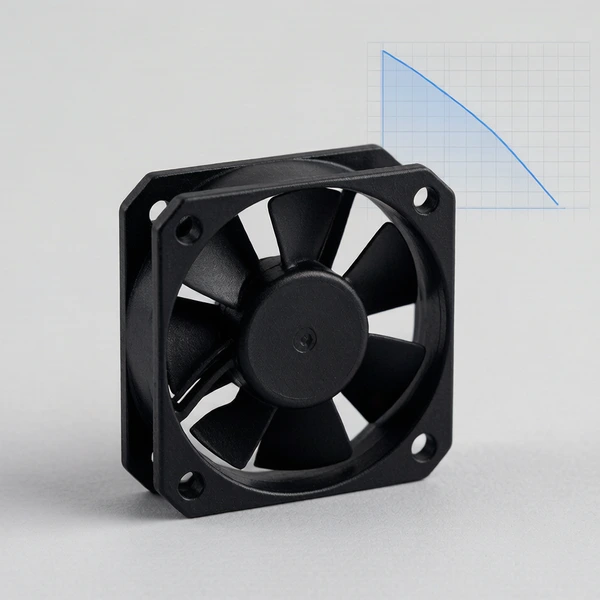
This is why the fan with the highest airflow number is not automatically the best power inverter fan.
Leave Enough Margin Without Oversizing
Some engineering margin is necessary because actual operating conditions change over time.
Filters may accumulate dust, ambient temperature can rise, and airflow paths may become more restrictive than expected. However, adding a large safety factor at every stage often produces an oversized fan.
The margin should reflect the application.
A clean indoor inverter with an open airflow path usually requires less additional capacity than an industrial VFD cabinet operating in a dusty environment with filters and high ambient temperature.
The goal is not to choose the smallest possible fan. It is to select a fan that can maintain acceptable temperatures under realistic worst-case conditions without adding unnecessary airflow, speed or power.
For critical designs, temperature testing in the actual inverter is more useful than simply increasing the fan specification "to be safe."
YCCFAN’s DC cooling fans for inverters span the voltage and PWM interface options that inverter cabinets commonly specify.
Match the Fan Voltage and Electrical Interface
After the airflow requirement is understood, electrical compatibility becomes equally important.
DC inverter fans are commonly available in 12 V, 24 V and 48 V versions. The correct voltage must match the fan supply circuit inside the inverter rather than simply matching the inverter's nominal system voltage.
This becomes especially important when replacing a VFD cooling fan. Two fans can have identical dimensions but still be electrically incompatible.
Check rated voltage, allowable voltage range, running current, startup current, connector type and pinout before approving a replacement.
If the original fan also provides speed feedback or accepts a PWM control signal, those functions must be considered as part of the replacement specification.
Choose the Right Fan Size Without Automatically Going Larger
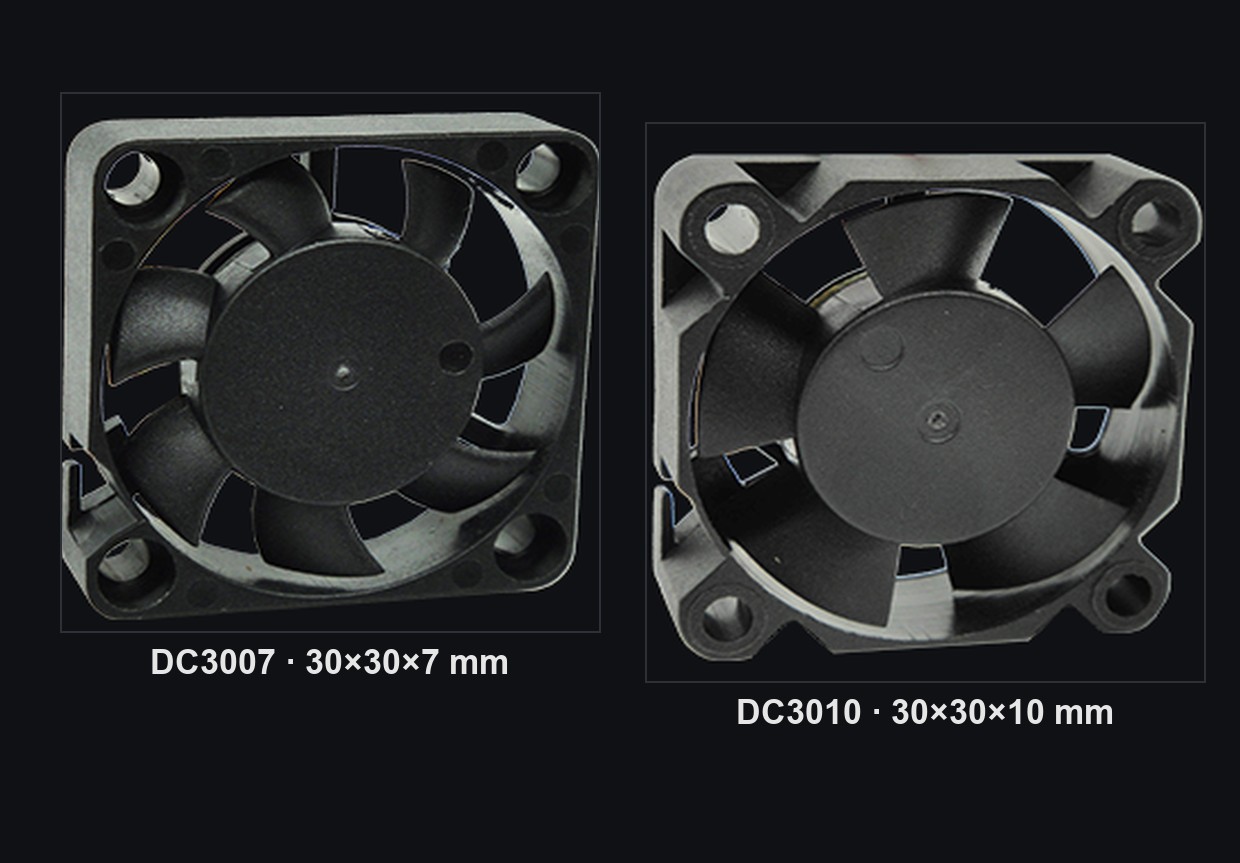
Common DC fan sizes include 40 mm, 60 mm, 80 mm, 92 mm and 120 mm frames, together with larger industrial formats.
A larger fan can sometimes provide the required airflow at a lower rotational speed, which can help reduce noise. However, increasing fan size may also require a larger enclosure opening, new mounting points and changes to the grille or internal layout.
More importantly, a larger fan can change how air moves through the cabinet. Higher total airflow is not useful if the air bypasses the components or heatsinks that actually need cooling.
For an existing inverter design, it is often better to first find a fan that meets the required airflow and pressure within the existing mechanical space before increasing the frame size.
Axial Fan or Centrifugal Blower?
Most inverter and VFD cooling systems use axial fans because they are compact and efficient when air can move relatively directly through the enclosure.
An axial fan is usually suitable when the intake, heatsink and exhaust path have low to moderate resistance.
A centrifugal blower becomes more appropriate when air must move through a narrow duct, dense heatsink or highly restrictive path. Blowers can generally provide stronger pressure performance and can also be useful when airflow needs to change direction.
The correct choice therefore depends on airflow resistance and cabinet geometry rather than assuming that one fan type is always better.
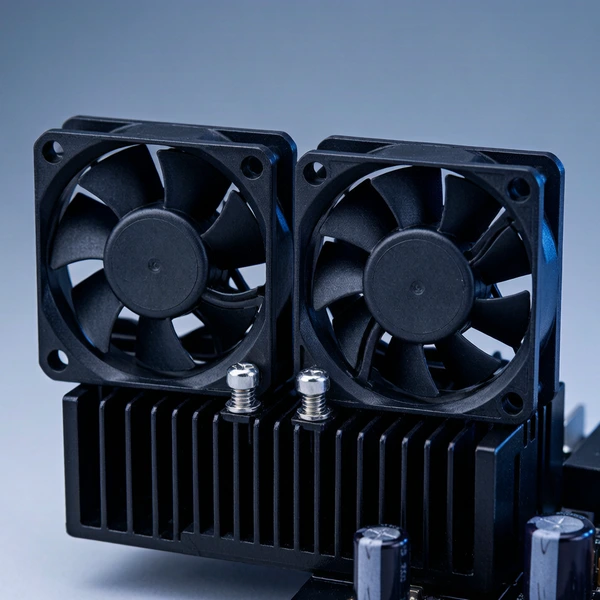
Improve the Airflow Path Before Increasing CFM
A stronger fan cannot fully compensate for a poor airflow path.
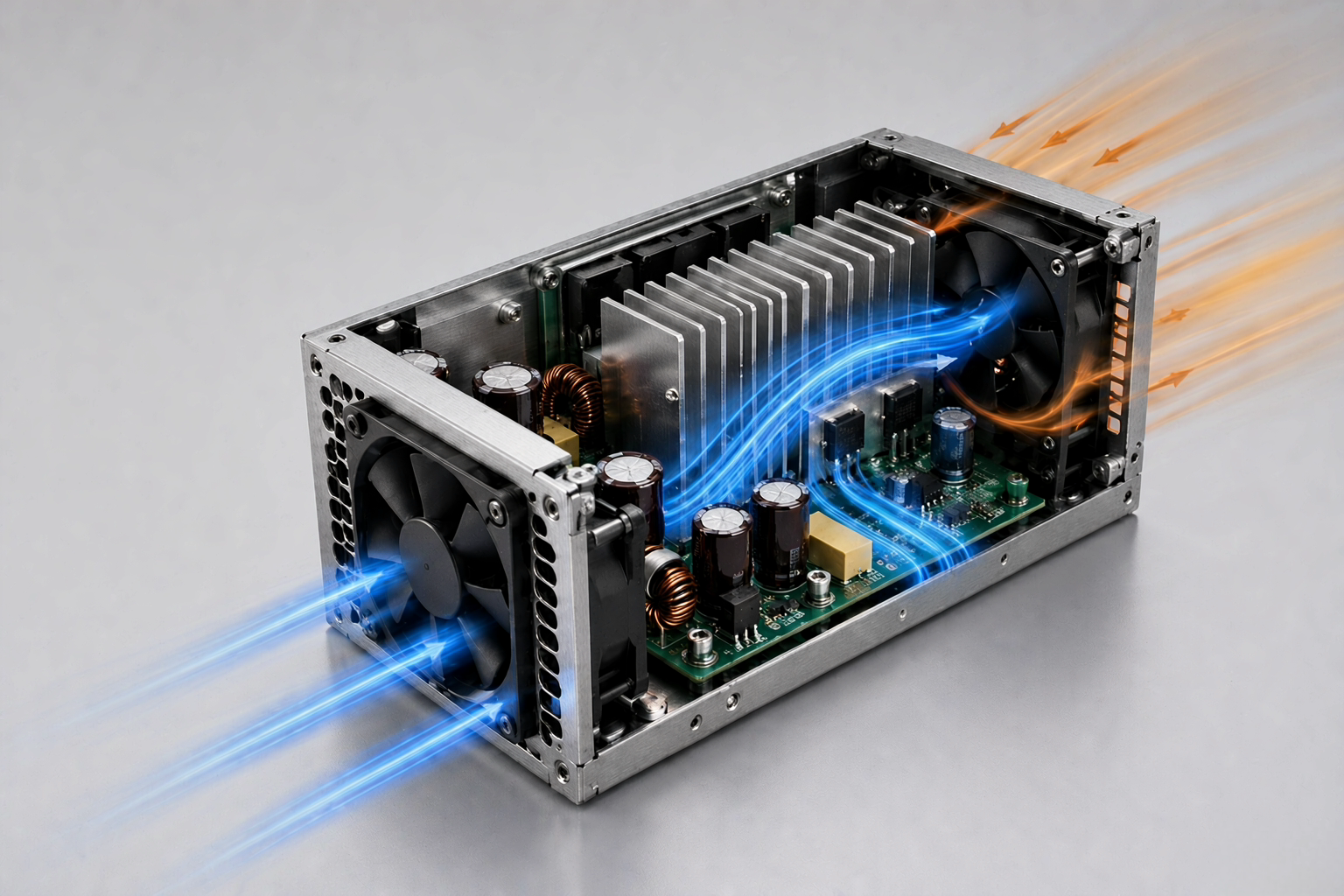
Air naturally follows the easiest route. If the intake and exhaust are positioned poorly, some airflow may bypass the hottest components. Hot exhaust air can also return toward the intake and reduce cooling effectiveness.
Inside an inverter cabinet, incoming air should be guided through the areas that generate the most heat before leaving the enclosure. Large cable bundles, small vents, restrictive grilles and poorly positioned filters can all interfere with this flow.
In some cases, improving the vent area or changing the internal airflow path can reduce temperatures more effectively than installing a significantly larger fan.
Before increasing fan capacity, it is worth checking whether the real limitation is the fan itself or the way air moves through the inverter.
Do You Need a 2-Wire, 3-Wire, or 4-Wire Fan?
The number of wires affects how the inverter can control and monitor the fan.
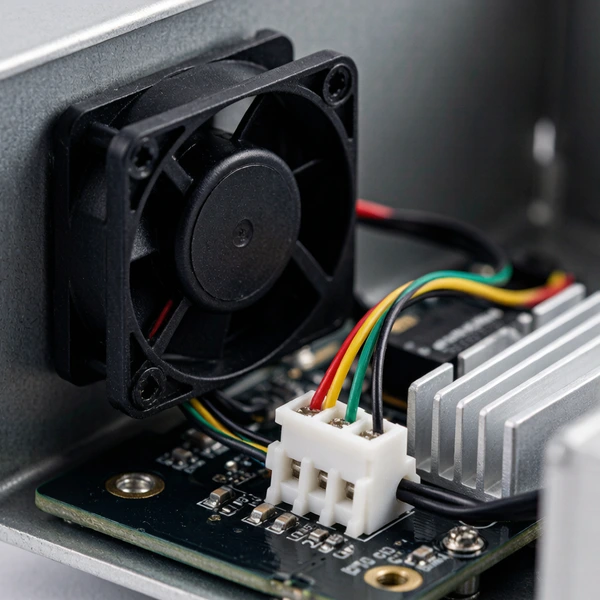
A 2-wire fan normally provides power and ground and is suitable for basic fixed-speed or on/off cooling. A 3-wire fan usually adds a speed-feedback signal, allowing the controller to detect whether the fan is rotating.
A 4-wire fan typically adds PWM speed control. This allows the inverter to adjust fan speed according to temperature or operating load.
For applications with changing thermal demand, PWM control can help avoid unnecessary full-speed operation. The fan can run more slowly during light-load conditions and increase speed when additional cooling is required.
This can be a better solution than simply installing an oversized fan and running it at maximum speed continuously.
Consider Noise and Fan Life
Higher fan speed generally produces more airflow and pressure, but it can also increase noise.
For an industrial VFD installed in a machine room, acoustic performance may be less important. For residential power equipment, office environments or wall-mounted inverters, fan noise may have a much greater impact on product acceptance.
If the required cooling can be achieved with a larger fan running more slowly, that option may sometimes provide a better balance between airflow and noise.
Fan life also matters because inverter cooling fans may operate for long periods at elevated temperatures. Bearing type, operating temperature, speed, dust, humidity and vibration can all affect long-term reliability.
Rather than comparing fans by a single lifetime number, review the manufacturer's life specifications under conditions that are reasonably close to the real inverter application.
Select the Fan for the Real Operating Environment
The installation environment can significantly change fan requirements.
Dust is particularly important because filters add resistance, and that resistance can increase as the filter becomes dirty. A fan should therefore provide sufficient pressure capability not only when the filter is new, but also under realistic maintenance conditions.
High ambient temperature is another concern. When inlet air is already hot, there is less thermal margin available for cooling. The fan motor and bearings also operate under greater thermal stress.
Outdoor or industrial cabinets may additionally require protection against humidity, dust or other contaminants. If a specific protection level is required, it should be verified against the actual fan specification rather than assumed from the fan's appearance or general product category.
What Should You Compare Before Selecting an Inverter Fan?
A useful fan specification should bring the main thermal, electrical and mechanical requirements together.
| Parameter | What to Check |
|---|---|
| Cooling demand | Actual heat that needs to be removed |
| Required airflow | Air volume needed under operating conditions |
| Static pressure | Resistance created by the system |
| Fan curve | Airflow available at expected pressure |
| Voltage/current | Compatibility with the fan supply |
| Dimensions | Frame size, thickness and mounting |
| Control | Fixed speed, PWM or other control |
| Feedback | FG, RD or alarm output if needed |
| Noise | Acceptable acoustic level |
| Environment | Temperature, dust and humidity |
| Lifetime | Suitability for expected duty |
This gives engineers and purchasing teams a more reliable basis for comparing candidate fans than airflow alone.
Example: Comparing Two Fans for an Inverter
Assume an inverter needs approximately 90 CFM of useful airflow under its expected operating conditions.
Fan A is rated slightly above 90 CFM in free air, but its performance falls quickly once resistance increases. Fan B has a somewhat higher airflow rating and better pressure capability.
After the heatsink, grille and cabinet resistance are considered, Fan A may no longer provide enough airflow, while Fan B still meets the requirement.
In this case, Fan B is the better choice.
However, moving immediately to a fan rated at 180 or 200 CFM would not necessarily improve the design. Unless thermal testing or system resistance shows that the extra capacity is required, the larger fan may simply add noise, power consumption and cost.
This illustrates the main principle of inverter fan selection: choose the fan according to its installed performance, not the largest number on the datasheet.
Common Inverter Fan Selection Mistakes
- Comparing fans only by free-air CFM.
- Using the inverter's total power rating as if it were the heat that needs to be removed.
- Selecting a replacement fan only because its frame dimensions match, while voltage, airflow direction, connector, control signals and pressure performance differ.
These mistakes all come from treating the fan as an isolated component rather than part of the inverter's complete cooling system.
When Is a Larger Inverter Fan Actually Necessary?
A larger or higher-performance fan is justified when calculations or testing show that the existing fan cannot maintain acceptable temperatures.
This may happen when inverter power density increases, a more restrictive heatsink is introduced, filters are added, cabinet ventilation becomes smaller or the ambient-temperature requirement rises.
In those cases, increasing fan capacity is solving a measurable thermal problem.
If the existing cooling system already maintains acceptable temperatures under the worst expected condition, significantly increasing fan size or CFM may provide little practical benefit.
How to Specify an Inverter Fan to a Supplier
When requesting an inverter fan for a new product or replacement project, provide more than the required frame size.
Useful information includes the available DC voltage, installation dimensions, expected airflow, approximate system resistance, ambient-temperature range and required control interface. Details about the heatsink, filter, grille and airflow path can also help the supplier evaluate suitable fan curves.
For replacement projects, include the original fan specification, connector, airflow direction and control signals whenever possible.
This application-based approach makes it easier to identify a fan that provides enough cooling without unnecessarily increasing size, power or airflow.
Final Selection Rule: Choose for the Real Operating Point
The most reliable way to select an inverter fan without oversizing it is to focus on the fan's real installed performance.
Start with the inverter's actual cooling demand. Then consider how much resistance is created by the heatsink, filter, grille and enclosure. Use the fan's P-Q curve to determine whether it can provide sufficient airflow under those conditions.
After that, verify voltage, current, dimensions, control signals, noise, operating environment and expected life.
The best inverter cooling fan is not necessarily the largest fan or the model with the highest airflow rating. It is the fan that provides enough airflow at the inverter's actual operating point, with a reasonable margin and without unnecessary excess capacity.
FAQ
Is a higher-CFM fan always better for an inverter?
No. Maximum CFM usually describes low-resistance performance. In a real inverter, filters, grilles and heatsinks can reduce airflow. Static-pressure performance and the real operating point are more important than free-air CFM alone.
Can I replace an inverter fan with another fan of the same size?
Not based on dimensions alone. The replacement should also match voltage, current, airflow direction, connector, pressure performance and any PWM or speed-feedback functions used by the inverter.
Should an inverter use a PWM fan?
PWM control is useful when cooling demand changes significantly with inverter load or temperature. It allows the controller to reduce unnecessary fan speed during light conditions while retaining higher cooling capacity when needed.
Browse DC fans for power electronics applications such as inverters, converters and drives.