





Fans in Series vs Parallel: Which Setup Increases Airflow or Static Pressure?
Adding a second cooling fan sounds simple. If one fan delivers 20 CFM, two fans should deliver 40 CFM—or twice the static pressure.
That assumption is only partly correct.
What changes depends on where the second fan is installed.
When two fans are placed one behind the other in the same airflow path, they are operating in series. This arrangement mainly increases the pressure capability available to push air through a restrictive system.
When two fans sit side by side and move air through separate portions of the same opening, they operate in parallel. The main purpose is to increase the available airflow.
AMCA summarizes the ideal relationship clearly: two identical fans in parallel can provide twice the airflow at the same static pressure, while two identical fans in series can provide twice the static pressure at the same airflow.
Real equipment is less tidy than those equations. Filters, heat sinks, server chassis, narrow vents and fan-to-fan interaction change the final operating point. So when comparing fans in series vs parallel, the useful question is not simply "Which one is more powerful?"
It is:
Does the system need more airflow, or does it need more pressure to maintain airflow through resistance?
Series and Parallel Fans Solve Different Problems
The difference is easiest to understand by looking at the airflow path.
| Configuration | Fan Arrangement | Main Effect | More Suitable When |
|---|---|---|---|
| Series | One fan behind another | Higher static pressure capability | Air must pass through restrictive components |
| Parallel | Fans side by side | Higher airflow capability | A larger volume of relatively unrestricted air is needed |
| Single higher-performance fan | One airflow path | Depends on selected fan curve | Space, noise or control favors one fan |
For ideal identical fans, AMCA represents parallel operation as:
Static Pressure₂ = Static Pressure₁
Airflow₂ = 2 × Airflow₁
For series operation:
Static Pressure₂ = 2 × Static Pressure₁
Airflow₂ = Airflow₁
These are useful curve-building relationships, not a promise that a finished enclosure will deliver exactly twice the measured CFM or pressure.
The actual system settles at the point where the combined fan performance and the system resistance meet.
What Happens When Cooling Fans Are Installed in Series?
With cooling fans in series, the same stream of air passes through both fans.
Imagine a compact server module with one fan at the front and another farther downstream. Air entering the system must pass through both fans before leaving the chassis.
The second fan does not create a second independent airflow path. Instead, both fans contribute pressure to the same path.
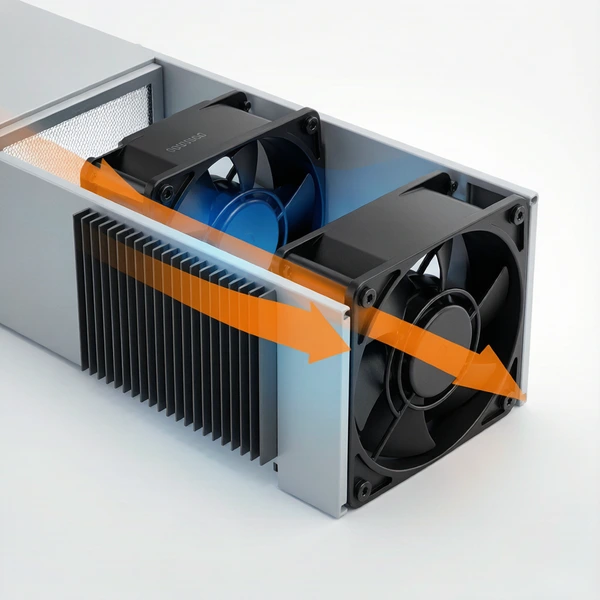
That makes series operation attractive when airflow has to pass through components such as dense heat sinks, long internal channels, filters or tightly packed electronics.
Suppose one fan can generate the airflow you need in an open test but loses too much airflow once the equipment is assembled. The problem may not be a lack of free-air CFM. The fan may simply lack enough pressure capability at the required airflow.
Adding another suitable fan in series shifts the combined pressure-airflow characteristic upward. In the idealized AMCA relationship, two identical fans can produce twice the static pressure at a given airflow.
That does not mean airflow itself remains unchanged after installation. The additional pressure changes where the combined fan curve intersects the system resistance curve, so the real operating airflow can increase.
The important point is that the increase comes from having more pressure available to overcome resistance, not from directly adding the two free-air CFM ratings.
A Simple Example of Why Series Fans Help in a Restrictive System
Consider a cooling path where the required airflow is 15 CFM.
A single fan may be rated for 25 CFM in free air, yet once air has to pass through a heat sink and restrictive vent, the fan may only deliver 11 CFM at the required static pressure.
At first glance, that can look strange. The fan specification says 25 CFM, so why is the system only seeing 11 CFM?
The 25 CFM figure describes a different operating condition.
If a second compatible fan is placed in series, the combined system gains more pressure capability at the same airflow range. The operating point can then move to a higher airflow value.
The design goal is not:
25 CFM + 25 CFM = 50 CFM.
The design goal is:
Can the combined fans provide at least 15 CFM at the pressure resistance created by this equipment?
That is a much more useful way to evaluate a series arrangement.
What Happens When Fans Are Installed in Parallel?
With fans in parallel, each fan handles part of the total airflow.
Instead of placing one fan behind another, two or more fans are positioned side by side, normally drawing from a common inlet region and exhausting into the same enclosure or plenum.
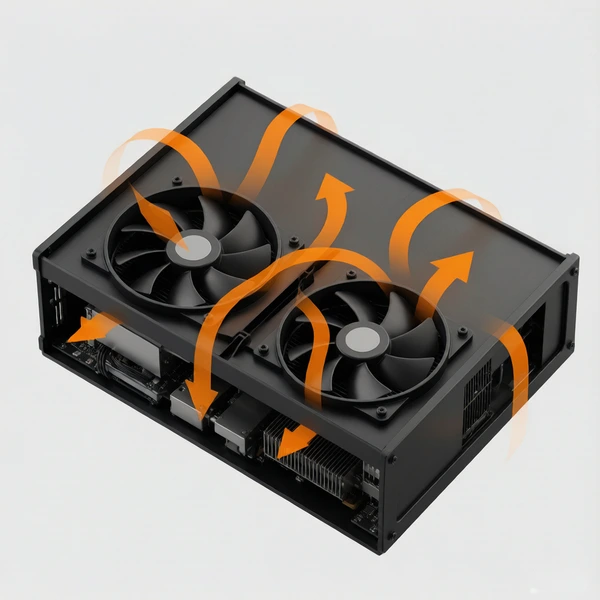
In the ideal fan-curve relationship, airflow from identical parallel fans is added at the same pressure. AMCA expresses this as twice the CFM while static pressure remains the same.
This arrangement makes sense when the cooling system needs a larger volume of air but does not require a large increase in pressure capability.
Common examples include wide server enclosures, equipment cabinets and electronic assemblies with a large intake or exhaust area.
Instead of forcing all the air through one small opening, several fans can distribute airflow across a wider section of the equipment.
That can also help with cooling coverage. Two fans positioned across a wide PCB or heat-generating area can direct air toward different sections of the system rather than relying on one fan to serve the entire width.
Why Two Parallel Fans Do Not Always Give Twice the Installed CFM
The "double airflow" rule describes the combined fan characteristic at the same pressure.
It does not mean that a system measured at 20 CFM with one fan will automatically measure 40 CFM after a second fan is added.
The equipment itself creates resistance.
AMCA describes the system resistance curve as increasing approximately with the square of airflow in turbulent systems. As flow rises, the pressure required to move that additional air rises quickly as well.
So when a second fan is added in parallel, the system does not stay at the original resistance point.
More air starts moving. That higher flow creates more pressure loss through the existing vents, filters, heat sinks and internal passages. The final operating point therefore lands somewhere between the single-fan condition and the theoretical maximum of twice the airflow.
For example, adding a second identical fan to a system that previously delivered 20 CFM might increase actual airflow substantially without reaching 40 CFM.
The exact result depends on the fan curves and the resistance of that specific system.
This is one of the most important details when engineers try to increase fan airflow with multiple fans.
More fan capacity is available, but the system decides how much of that additional capacity turns into real airflow.
High-Resistance Systems Can Make Parallel Fans Less Effective Than Expected
Imagine a narrow electronics enclosure with a dense filter and a tightly packed heat sink.
The design already requires significant static pressure.
A second fan is installed beside the first because the objective is to increase CFM.
The combined parallel fan curve now has more airflow capability, but both fans are still working against the same restrictive cooling path.
If pressure is the real limiting factor, the airflow improvement may be much smaller than expected.
In this situation, adding more parallel fans may use more space and electrical power without solving the actual bottleneck.
A series arrangement—or a single fan with a stronger pressure characteristic—may be more appropriate.
The opposite can also happen.
If an enclosure has very little resistance but simply needs to exchange a large amount of air, installing fans in series may add pressure capability that the system does not need. Side-by-side fans can make better use of the available area.
So "series for pressure, parallel for airflow" is more than a textbook definition. It identifies which part of the cooling system is currently limiting performance.
In high-resistance enclosures, high-static-pressure DC fans keep useful airflow where low-pressure fans running in parallel would stall.
Static Pressure Is Usually the Deciding Factor
The easiest way to choose between the two configurations is to look at what happens to airflow after the fan is installed.
If a fan has strong free-air airflow but loses much of it behind a dense heat sink, filter or narrow air passage, the system is pressure-limited.
The cooling design needs enough capability to increase static pressure at the required airflow.
Series fans can help in that situation.
If airflow remains relatively unrestricted but one fan simply cannot move enough total air through the equipment, the system is more likely volume-limited.
Parallel fans are the more natural option.
This distinction is also useful for compact high-performance DC fans.
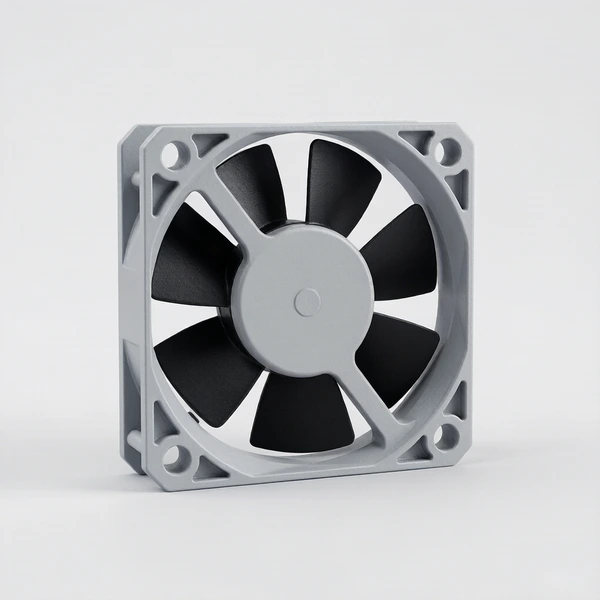
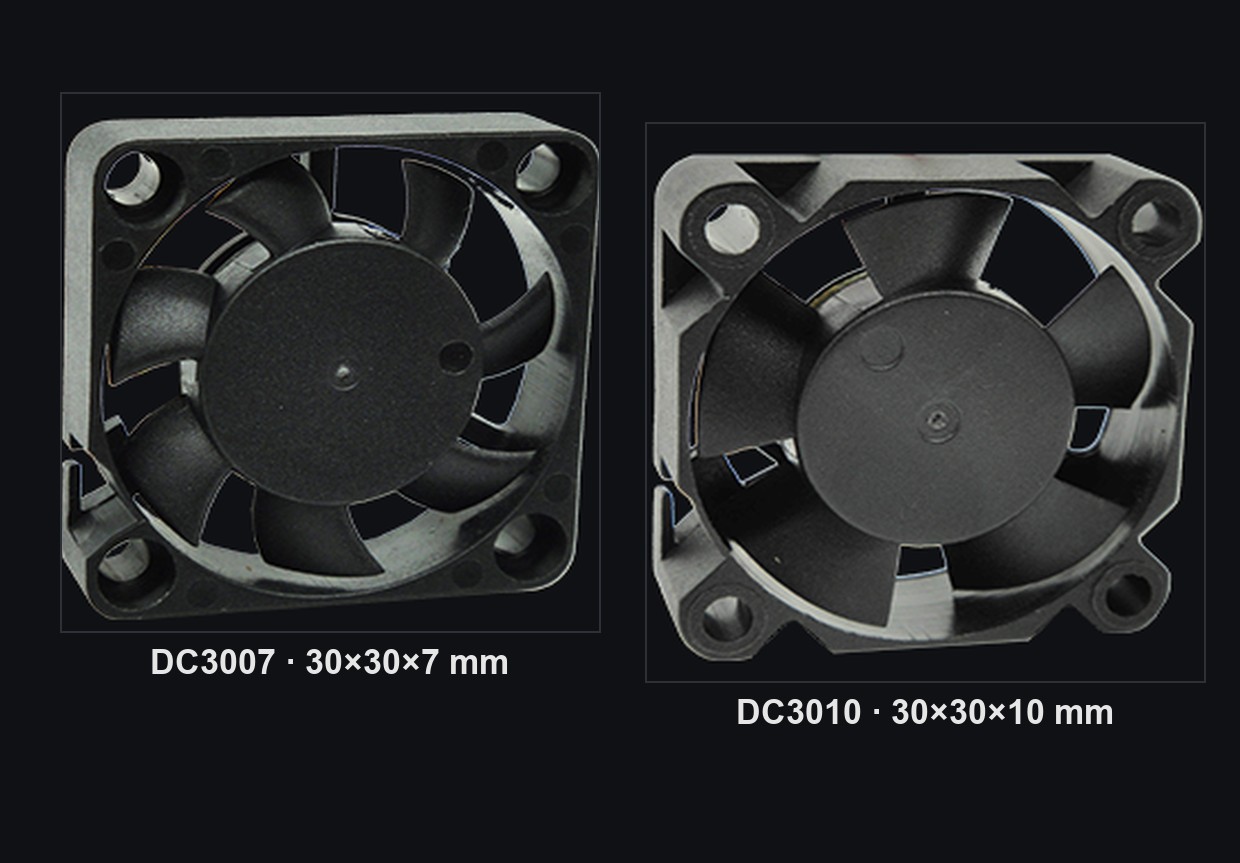
For example, YCCFAN's DC3828 is a 38 × 38 × 28 mm DC axial fan rated up to 22.05 CFM and 81.56 mmH₂O maximum static pressure, illustrating how individual fan designs can be optimized for both airflow and much stronger pressure performance in compact high-resistance applications.
A dual-fan arrangement should therefore not be chosen before checking whether a single fan with a more suitable pressure-airflow characteristic can meet the requirement.
Should You Stack Two Identical Fans Directly Together?
Two fans mounted one behind another are technically a series arrangement, but that does not automatically make them an optimized two-stage fan.
The airflow leaving the first fan is already rotating and has a non-uniform velocity profile. The second fan is therefore not operating under exactly the same inlet conditions it would see in an isolated performance test.
For small electronic equipment, the safest approach is to treat a stacked-fan assembly as a combined cooling component and verify its actual performance in the intended structure rather than assuming ideal mathematical addition.
Fan direction also matters.
Both fans must contribute to the same intended airflow path. Mounting two fans so that they work against each other does not create useful series pressure.
Space between fans, nearby structures and the geometry immediately upstream and downstream can also affect the result.
For applications that genuinely require a high-pressure two-stage solution, a configuration designed and validated for that operating condition is preferable to stacking two unrelated fans simply because they fit mechanically.
Parallel Fans Need a Balanced Airflow Path
Parallel operation has a different design challenge.
Each fan should have reasonable access to the inlet and outlet.
Suppose two identical fans are mounted side by side, but one sits behind a large open grille while the other is partially blocked by a cable bundle or internal structure.
The two fans no longer operate under the same resistance.
One branch may deliver more airflow than the other even though both fans have identical specifications.
The same problem can occur when one fan blows toward an open section of the PCB while the other faces a dense heat sink.
A good dual fan configuration therefore considers the airflow path around each fan, not only the number of fans installed.
For wide electronics systems, this can mean positioning fans so that each covers a meaningful thermal zone rather than putting two fans together in one corner and expecting total CFM alone to solve local hotspots.
What If One Fan Fails?
Multiple fans can also affect how a cooling system behaves after a failure.
In a parallel arrangement, a stopped fan creates an opening in the same pressure region used by the operating fan. Depending on the enclosure design, some air can take an unintended path through the inactive fan rather than through the intended cooling route.
In a series arrangement, a stopped fan remains directly inside the airflow path and creates additional resistance for the fan that is still running.
Neither arrangement should therefore be assumed to provide automatic full cooling redundancy simply because two fans are present.
Equipment that needs fault tolerance should evaluate the cooling condition with one fan stopped, including actual component temperature and remaining airflow.
FG or RD monitoring can also be used where the system needs to detect abnormal fan operation rather than waiting for temperature to rise.
Series or Parallel for Server and Electronics Cooling?
There is no configuration that is better for every server or electronic enclosure.
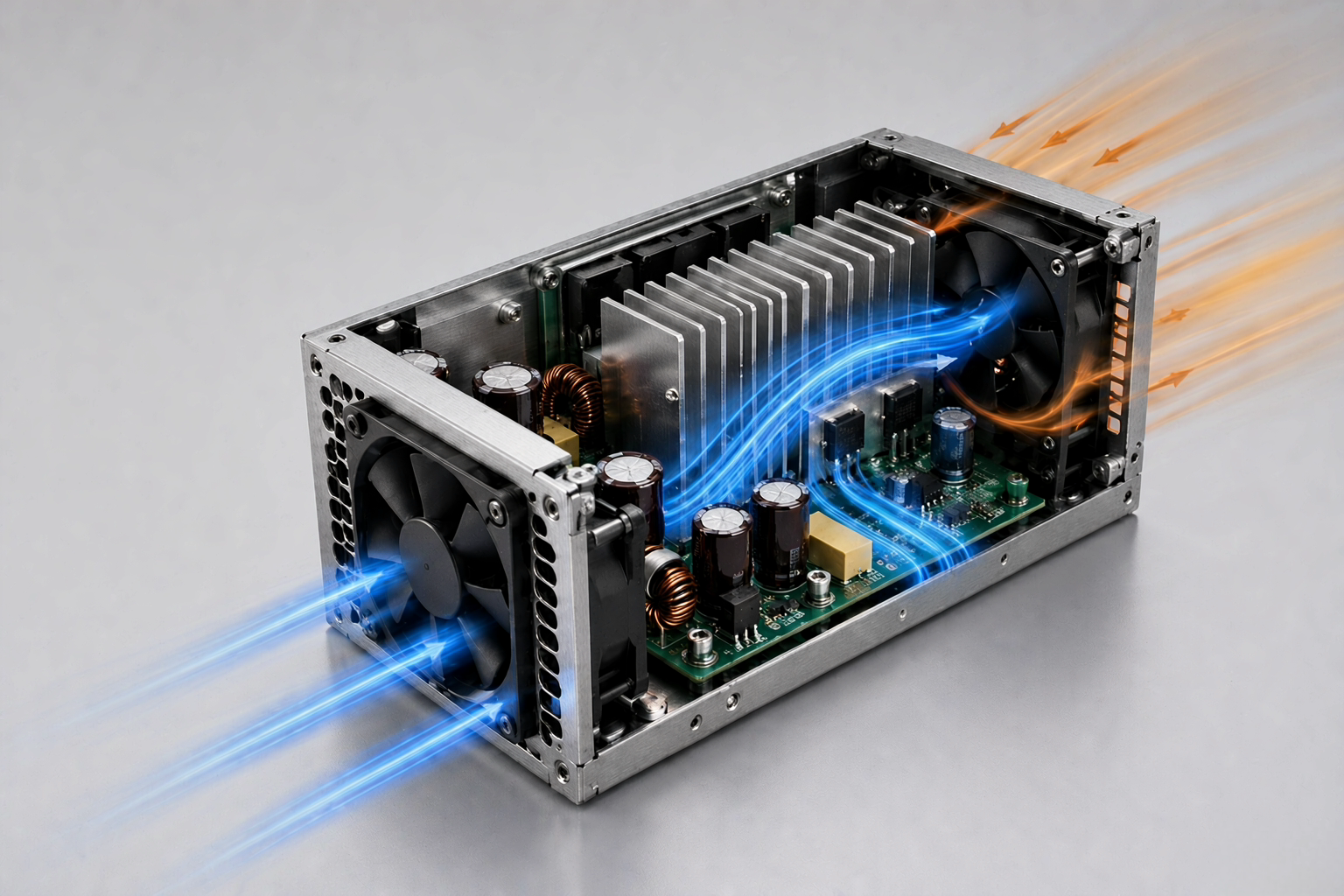
A front fan wall in a server often resembles parallel operation because several fans move air through adjacent portions of the chassis. The design benefits from greater combined airflow and broader coverage.
But server hardware can also create substantial resistance from drive cages, dense heat sinks, passive GPUs, filters and narrow internal passages.
Once pressure demand becomes high enough, the fan's pressure characteristic matters just as much as the number of fans.
Compact electronics may face the opposite limitation. There may be no room for two fans side by side, while the airflow path itself is narrow and restrictive. A deeper or multi-stage arrangement may then be considered.
YCCFAN's product range includes DC fans from compact sizes through larger cooling formats, while the company's own technical materials list airflow and pressure testing among its R&D and validation capabilities.
For a real project, the decision should start from the required operating airflow and system resistance rather than choosing series or parallel first.
How to Choose Between Fans in Series and Parallel
A practical decision can usually be made from two measurements: the airflow you need and the pressure the system creates at that airflow.
If the existing fan has enough free-air CFM but airflow collapses after filters, heat sinks or restrictive channels are added, investigate pressure capability. Series operation may be useful.
If the system is relatively open and a single fan simply cannot move enough total air, parallel operation is more likely to provide the improvement you want.
After selecting the configuration, check the combined performance against the actual system curve.
That last step matters because the number printed beside "maximum airflow" or "maximum static pressure" on a datasheet represents an endpoint of the fan curve. The cooling system normally operates somewhere between those endpoints.
The best configuration is the one whose operating point falls where the equipment actually needs it.
FAQ
Do two fans in series double the CFM?
No.
For two identical ideal fans in series, pressure is added at the same airflow rather than airflow being directly doubled. The extra pressure capability can move more air through a restrictive real system, but the final CFM depends on the system resistance curve.
Do two fans in parallel double airflow?
At the same static pressure, the ideal combined fan curve for two identical parallel fans has twice the airflow capability. In an installed system, actual airflow usually does not simply double because the higher flow also increases system pressure loss.
Are series fans better for static pressure?
Series operation is generally the more suitable arrangement when the objective is to increase pressure capability through a restrictive airflow path.
Two identical fans in series ideally add their static-pressure capability at the same airflow.
Should server fans be installed in series or parallel?
It depends on the cooling path.
Parallel fans are useful when the system needs more total airflow or broader coverage. A high-resistance server path may instead require stronger static-pressure capability. The fan curve and chassis resistance should be evaluated together rather than choosing the arrangement from CFM alone.
Final Takeaway
The difference between fans in series vs parallel comes down to what the cooling system is short of.
Series fans increase the available pressure capability. They are useful when air must continue moving through filters, dense heat sinks, narrow channels or other restrictive structures.
Parallel fans increase the available airflow capacity. They make more sense when a larger amount of air needs to move through a relatively open system or across a wider cooling area.
Neither arrangement guarantees an exact two-times improvement after installation.
The system resistance moves with airflow, and the final result is determined by the combined fan curve and the real operating point.
Instead of asking whether two fans are better than one, determine whether the current cooling problem is caused by insufficient airflow or insufficient pressure.
Once that is known, the choice between series and parallel becomes much clearer.
Browse DC fans by airflow and static pressure to decide whether series or parallel installation fits your system curve.